

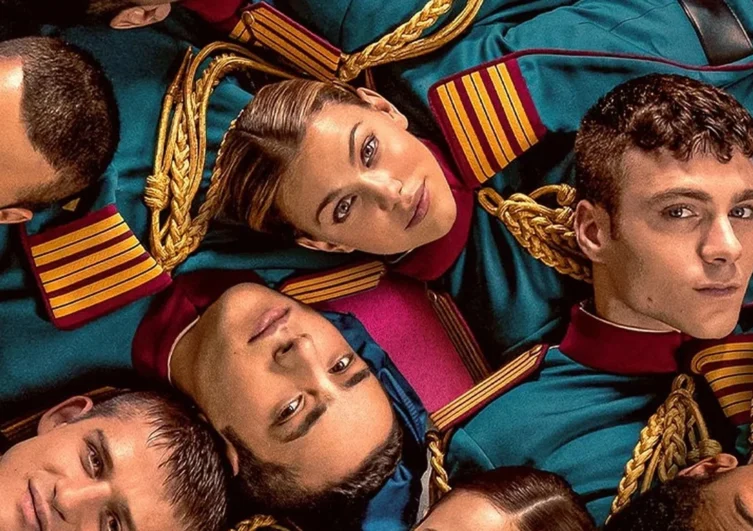
Netflix’s Minerva Academy is set in a fictional military high school in Naples, where teenagers live by rules that have very little to do with ordinary teenage life. They wake for flag ceremonies, wear uniforms, hand over their phones, study tactics and fencing, and learn fast that hierarchy matters. Netflix describes the series as a world of discipline, rivalry, family pressure and forbidden romance.
It is also a world obsessed with masculinity. Who is strong enough, who can take humiliation, who earns respect, who looks weak, who disappoints his father and who can survive among other boys without giving anyone a reason to wonder whether he belongs.
Into that environment, the series quietly introduces male same-sex attraction. Without spoiling anything, one of the young men finds himself facing feelings that don’t fit comfortably inside the version of masculinity expected of him. The attraction itself isn’t the most important part. The fear of anyone else finding out is, because Minerva Academy also shows the kinds of things that can happen when male homosexuality becomes visible inside an institution where masculinity is constantly being tested.
That fear has a very long military history.
The barracks were never the problem
Military life involves a degree of physical closeness that would be unusual almost anywhere else. Men sleep in the same rooms, change together, shower together and deploy together for months. In extreme conditions they depend on one another for protection, medical care and survival.
For generations, the presence of heterosexual men in these conditions was simply treated as normal. Then someone suggested one of them might be gay, and the barracks became a matter of national debate.
That wasn’t hypothetical. During the American debate over allowing gay people to serve openly, showers, berthing and shared living spaces repeatedly appeared in arguments against change. Congressional testimony around repeal pointed out the obvious contradiction: gay service members were already living in barracks, serving aboard ships and showering alongside heterosexual colleagues under Don’t Ask, Don’t Tell. The policy changed whether people could acknowledge being gay, not whether gay people were physically present.
The underlying anxiety was often some version of what if he’s attracted to me? Which raises an obvious question: why should attraction erase professional boundaries only when the person feeling it is gay? Straight men serve beside women they may find attractive. Straight women serve beside men they may find attractive. By that logic, bisexual people should apparently be unable to enter a room containing anybody.
Professional adults are expected to distinguish attraction from behaviour. Harassment is misconduct. Sexual assault is misconduct. Inappropriate relationships can be misconduct. Being gay is not. The room never changed. Only the knowledge did.
A threat to masculinity before anything else
Military objections to openly gay service were usually framed in institutional language: morale, discipline, privacy and unit cohesion. Cohesion genuinely matters. But research and the experience of forces that allowed gay personnel to serve openly made it increasingly difficult to demonstrate that homosexuality itself damaged military effectiveness.
RAND’s 2010 review found little evidence that allowing gay men and lesbians to serve openly would undermine military effectiveness, and it examined the experience of foreign forces that had already removed similar restrictions. The Pentagon’s own review that year ultimately assessed the overall risk to military effectiveness from repeal as low.
So why did the idea stick? Part of the answer is what the gay male soldier represented. For generations, the ideal military man came bundled with a very specific package: strength, stoicism, aggression when required, emotional restraint and heterosexuality. The first four can clearly matter in certain roles. The fifth never had anything to do with firing a weapon, reading a map or keeping another soldier alive. It just came in the same box, like a free pen nobody asked for.
A gay soldier challenged that stereotype simply by existing. He could be strong, disciplined, brave and capable of leading other men while still being attracted to them. The contradiction was never inside him. It was inside the stereotype. That policing of masculinity is hardly unique to military life either: football has spent decades wrestling with a remarkably similar double standard around gay men.
And sometimes the consequences of challenging that stereotype were not confined to dismissal papers or unpleasant conversations. Britain’s 2023 LGBT Veterans Independent Review testimony includes a British Army veteran who served between 1967 and 1974 and said that, after an investigation into his sexuality became known around the barracks, colleagues attacked him the day before Christmas, leaving dental injuries that continued to affect him years later.
Another veteran, who served in the Royal Navy between 1979 and 1990, recalled being bullied and beaten from the beginning of his service and being told to leave because he was not “man enough” to serve. His testimony described his life in the service as being made hell. That phrase, not man enough, gets very close to the centre of the issue. These were not disagreements about whether someone could operate equipment, follow orders or perform under pressure. Homosexuality had become evidence that a man had somehow failed masculinity itself.
And women complicate the picture
None of this means lesbians were somehow left alone. Military institutions discriminated against them too. Britain’s pre-2000 policy explicitly treated both male and female homosexuality as incompatible with service, and a person could be required to leave simply for being homosexual, regardless of whether they had ever engaged in same-sex sexual activity.
The American record is particularly striking. A GAO review of Department of Defense policy found that women were discharged for homosexuality at rates disproportionately higher than their representation in the armed forces during the 1980s. So the historical distinction is not that lesbians were accepted while gay men were persecuted.
It is that male homosexuality collided with a particularly rigid idea of what a soldier, and therefore a man, was supposed to be. A woman attracted to another woman violated heterosexual expectations. A man attracted to another man was often treated as though he violated the definition of the soldier itself.
Waiting to be discovered
This is where Minerva Academy touches something darker without needing to lecture anyone about military history.
For gay personnel under exclusion policies, the closet wasn’t about avoiding an awkward conversation. It could mean protecting an entire career. Britain’s independent review recorded intrusive investigations, searches of personal belongings, humiliating questioning, psychiatric examinations, blackmail, bullying, assault and dismissal. Some personnel were pressured to identify other gay service members, while others deliberately entered heterosexual relationships or avoided ordinary social conversations because they feared raising suspicion.
Picture the closet in that setting. You’re surrounded by the same people nearly every hour of the day. They know where you sleep and when you go out. They ask what you did at the weekend. They talk about girlfriends and wives, relationships, break-ups and who went home with whom after a night out. The gay man is expected to participate in all of it while making sure nobody learns the equivalent information about him.
That isn’t really privacy. It’s surveillance, performed by the person on himself. The testimony collected by the review includes personnel who described living double lives, inventing cover stories and leaving careers they loved because the fear of discovery became unbearable. These were not people avoiding work. They were expending energy hiding parts of their lives so that they could continue doing it.
The British government has since acknowledged the harm caused by the ban and introduced restorative measures. As of September 2026, eligible veterans can receive financial recognition payments of up to £70,000, alongside non-financial measures including official apologies and restored service items.
What Minerva Academy gets right without saying very much
That’s why the queer storyline matters. The series doesn’t need to turn a character into a walking lecture on military discrimination. It puts a young man inside an institution where male approval carries enormous weight and shows the kinds of consequences that can follow when homosexuality becomes visible in a culture where being seen as insufficiently masculine can alter how other men treat you.
The fear isn’t simply what if I like another man? It is much more practical: what happens to my place among these men if they know? Will they still see me as one of them? Will they trust me in the same way? Will I become a joke, a target or simply somebody they suddenly look at differently? Those questions help explain why the closet became so powerful in military environments even though a gay man’s actual ability to serve did not change when somebody discovered his sexuality. For viewers who want to see how Minerva Academy handles that tension for themselves, the series is currently streaming on Netflix.
Gay men served when homosexuality was forbidden. They slept in the same barracks, used the same showers, deployed to the same wars and depended on the same colleagues, often while knowing that those colleagues or the institution above them could turn against them if the truth became known. The military had therefore been functioning alongside gay men all along. What eventually changed was not their ability to serve, but the requirement that they conceal who they were in order to be allowed to do it.
And that may be the point worth taking from Minerva Academy without spoiling a single thing that happens. For generations, men were told that military service demanded courage, discipline and the ability to stand beside another man when things became dangerous. Somehow, we then created institutions in which admitting that you could love another man might itself become one of the most dangerous things to say.

Leave a Reply