

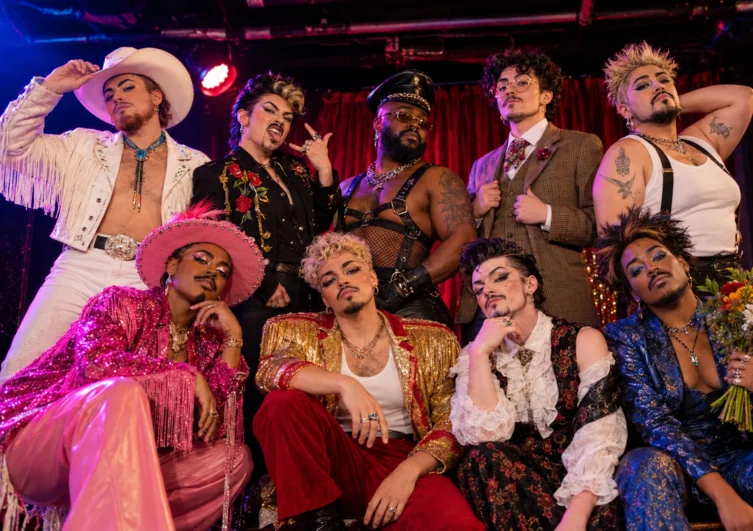
Everyone knows RuPaul. Even your grandmother probably knows what a drag queen is. But ask someone to name three drag kings, and the conversation might suddenly become rather quiet.
For nearly two decades, RuPaul’s Drag Race has helped transform drag queens into international celebrities. There are television franchises, world tours, fashion campaigns, music careers and entire businesses built around the art of exaggerated femininity.
Drag kings, meanwhile, have spent years doing something equally creative, outrageous and entertaining, often without anything close to the same recognition.
They have their own legends, dedicated audiences and thriving underground scenes. They can be glamorous, hilarious, seductive, political or completely ridiculous. Sometimes all five in a single performance.
And in 2026, with the arrival of the second season of King of Drag, they are finally getting something that has been missing from mainstream entertainment: a television platform entirely devoted to their art.
So what exactly is a drag king? And why, in an industry that celebrates breaking gender rules, have the kings spent so much time standing in the queens’ shadows?
What exactly is a drag king?
The simplest explanation is that a drag king is a performer who uses clothing, makeup, movement and theatricality to create a masculine character.
But describing drag kings as the male equivalent of drag queens doesn’t quite capture what makes their performances interesting.
A drag king might appear onstage as a ridiculously confident rock star, an ageing lounge singer, a seductive cowboy, a boy-band heartthrob or the sort of man who believes owning a podcast qualifies him to explain the entire world.
The possibilities are practically endless.
Some performers use facial hair, contouring and elaborate costumes to create convincing masculine appearances. Others deliberately exaggerate every recognisable male stereotype, transforming masculinity into something so absurd that the audience cannot help laughing.
And not every king is trying to look like a conventional man. Some performances mix masculine and feminine elements, while others explore androgyny, fantasy or identities that resist categorisation.
Drag kings can be cisgender women, transgender men, non-binary people or performers of other gender identities. Drag is a form of performance, not a reliable indication of someone’s gender or sexuality.
That distinction matters, particularly because drag kings are sometimes mistakenly described as exclusively lesbian women dressing as men.
Lesbian performers have played an important role in drag king culture, but the art form has always been more complicated than that.
At its best, kinging takes something we encounter every day — masculinity — and turns it into entertainment.
Sometimes the joke is about men. Sometimes it’s about society’s expectations of them. And sometimes it’s simply about creating a character so charismatic that everyone in the room wants his attention.
Drag kings were famous long before RuPaul
One of the strangest things about drag king history is that performers presenting as men were once genuine entertainment celebrities.
During the nineteenth and early twentieth centuries, performers known as male impersonators became popular attractions in British music halls and American variety theatres.
Among the most famous was Vesta Tilley, born Matilda Alice Powles in 1864.
Tilley performed dressed as fashionable young men, soldiers and other masculine characters, developing a reputation for her sharp observations of male behaviour.
She became an enormously successful entertainer, touring internationally and earning considerable fame.
In America, Annie Hindle was another pioneering figure. Arriving from England in the nineteenth century, she built a career performing masculine characters and challenging expectations about what women could do onstage.
These performers were not drag kings in exactly the contemporary sense. Their theatrical traditions, audiences and social circumstances were different.
But they demonstrate something important: the idea of women performing masculinity for entertainment is hardly a recent invention.
The modern drag king scene developed much of its distinctive identity during the late twentieth century, particularly through lesbian, feminist and queer performance communities.
By the 1990s, drag king troupes and dedicated events had become established in cities including New York, London and San Francisco.
Yet while drag queens were increasingly entering mainstream popular culture, drag kings remained far more closely associated with independent nightlife and alternative performance spaces.
The kings had history, talent and audiences.
What they didn’t have was a RuPaul.
How did drag queens become superstars while kings stayed underground?
When RuPaul’s Drag Race premiered in 2009, it changed the commercial possibilities of drag.
The programme introduced audiences to the elaborate machinery behind drag performance: makeup, wigs, costumes, choreography, comedy and the occasional spectacular disaster.
It also gave viewers something television understands extremely well: personalities.
Contestants became characters that audiences could support, criticise, imitate and follow long after their seasons ended.
A successful appearance could lead to touring opportunities, merchandise, television work and an international fanbase.
That level of exposure helped establish a powerful entertainment industry around drag queens.
But drag kings did not receive an equivalent platform.
For years, the world’s most recognisable drag competition built its identity around queens, leaving other forms of drag largely outside the format.
This created a self-reinforcing problem.
Television made certain performers famous. Famous performers attracted audiences and commercial opportunities. Producers and venues could then point to that popularity as evidence of what audiences wanted.
Meanwhile, drag kings were often left trying to prove the commercial potential of an art form that had never received the same promotional investment.
It would be simplistic to attribute the entire difference to television. Drag queen and drag king scenes have distinct histories, aesthetics and audiences.
But visibility matters.
And when one group has spent years appearing on major television platforms while another has relied heavily on local venues, it is hardly surprising that their public recognition looks different.
Meet the drag kings who have already broken through
Despite the imbalance, several drag kings have built careers that challenge the idea that audiences are interested only in queens.
Landon Cider became a landmark figure in 2019 when he won the third season of The Boulet Brothers’ Dragula.
His performances combine elaborate prosthetics, horror-inspired aesthetics and extraordinary visual transformations.
Cider’s victory was significant because it demonstrated that a drag king could compete successfully in a televised drag competition, even one with an established alternative-drag identity.
Then there is Murray Hill, whose approach could hardly be more different.
With his tailored suits, old-fashioned showbusiness charm and gloriously self-confident personality, Hill has developed a character that resembles a lounge entertainer from another era.
His career has included comedy, cabaret, acting and appearances in productions such as HBO’s Somebody Somewhere.
Hill also hosted the first season of King of Drag in 2025, bringing decades of performance experience to a new generation of artists.
And then there is King Molasses, the winner of that inaugural season.
Molasses became one of the programme’s most recognisable faces, drawing attention not only to their performances but also to the limited opportunities drag kings encounter within the entertainment industry.
These artists do not share a single aesthetic or performance style.
And that’s precisely the point.
There is no universal drag king look, just as there is no single way to be a drag queen.
The possibilities extend far beyond fake moustaches and men’s suits.
King of Drag is finally giving the kings their own television moment
In June 2025, LGBTQ+ streaming platform Revry premiered King of Drag, a reality competition devoted specifically to drag king performers.
It was a significant development for an art form that had spent decades waiting for sustained mainstream television attention.
Rather than treating kings as occasional guests in a format designed for queens, the programme allowed them to demonstrate their abilities on their own terms.
The contestants faced performance challenges that tested comedy, character creation, musicality, visual presentation and stage presence.
More importantly, viewers could see the range of identities and approaches that exist within drag king culture.
The series returned for a second season on 20 September 2026, with comedian Cameron Esposito replacing Murray Hill as host.
The new cast includes performers such as Chase Lounge, Papi Culo, Trade and Twinka Masala, while the judging line-up features names associated with RuPaul’s Drag Race and other LGBTQ+ entertainment.
The second season also expands the production, offering eight episodes and a larger platform for its contestants.
For people who have spent years watching drag queens dominate reality television, there is something refreshing about seeing the format applied to another part of drag culture.
But a television show alone cannot solve decades of unequal recognition.
The real test is what happens when the cameras stop rolling.
Will the contestants receive more bookings? Will venues invest in king-led productions? Will audiences continue following these artists outside the programme?
Those questions matter more than simply declaring that drag kings are finally having their moment.
Is there sexism in the drag world?
This is where the conversation becomes considerably more uncomfortable.
Drag is often celebrated as an art form that challenges traditional gender expectations. It allows performers to exaggerate, reinvent and ridicule the rules society attaches to masculinity and femininity.
So why do some of those hierarchies appear to survive inside drag itself?
Several drag kings have spoken publicly about receiving fewer bookings, lower fees and less recognition than drag queens.
In interviews with Them, performers described barriers to appearing on RuPaul’s Drag Race and argued that the exclusion of kings reflected broader assumptions about whose performances were considered commercially attractive.
A 2025 academic study examining drag kings’ experiences in queer spaces also identified concerns involving unequal booking opportunities, tips and gendered expectations.
Some performers have linked these experiences to misogyny and the tendency to undervalue artists perceived as women or associated with female masculinity.
That does not mean drag queens are collectively responsible for the problem, nor does it mean every venue treats performers differently.
Many queens actively support kings, collaborate with them and help create opportunities for a wider range of drag artists.
It also doesn’t erase the discrimination that drag queens themselves have experienced.
But a community can challenge discrimination in the wider world while still reproducing inequalities within its own institutions.
And there is a particularly interesting contradiction here.
Mainstream audiences have enthusiastically embraced exaggerated femininity as an elaborate artistic spectacle.
Exaggerated masculinity, however, has often been treated as something with less obvious entertainment value.
Perhaps part of the problem is familiarity.
People already recognise masculine behaviour in everyday life. The confident businessman, the arrogant musician, the seductive stranger and the hopelessly self-important man are characters we encounter constantly.
But in the hands of a skilled drag king, those familiar behaviours become extraordinary precisely because they are exposed as performances.
A king can turn an ordinary male gesture into a punchline, a seduction or a political statement.
And sometimes, a perfectly timed adjustment of an imaginary tie can say more about masculinity than an entire lecture.
Can drag kings become as famous as drag queens?
There is no shortage of reasons to believe that drag kings have room to expand their audiences.
Social media allows performers to reach people far beyond the venues where they appear. Independent drag communities continue to create events, collaborations and new opportunities.
And King of Drag has demonstrated that there is an audience for a dedicated television competition.
But becoming as famous as drag queens is not necessarily the only measure of success.
Not every drag king wants a reality television career, a sponsorship deal or international celebrity.
For some, the appeal of drag lies precisely in its experimental nature, its connection to local communities and the freedom to create without satisfying mainstream expectations.
The challenge is making sure that artists who do want larger opportunities can access them.
That means more varied bookings, greater visibility, better professional support and audiences willing to look beyond the most familiar forms of drag.
It also means recognising that drag kings are not simply waiting to become the next drag queens.
They already have an artistic tradition, distinctive performance styles and a community worth celebrating.
Perhaps the most revealing thing about the rise of King of Drag is how long it took television to realise something audiences in queer clubs have known for years.
Drag kings can sing, dance, entertain, seduce, provoke and make an entire room collapse with laughter.
They can be handsome, ridiculous, terrifying or spectacularly badly behaved.
And they can do all of it while exposing just how theatrical masculinity has always been.
The queens have had their crowns for years.
It’s about time the kings got a little more attention.

Leave a Reply