

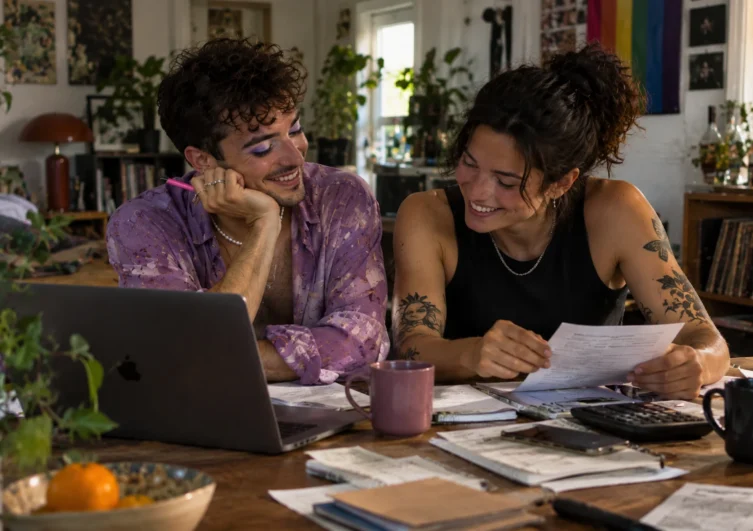
Forget finding your soulmate. What if the perfect marriage was simply two best friends, a shared mortgage, separate love lives and absolutely no arguments about who forgot your anniversary? Welcome to the unexpected revival of the lavender marriage.
Imagine marrying your best friend. You already know each other’s terrible habits, questionable dating history and embarrassing family stories. You trust each other, enjoy spending time together and agree that the rent is becoming an increasingly offensive monthly event.
There is just one small detail: you are not romantically interested in each other.
For some members of Gen Z, that sounds less like a problem and more like an excellent business proposal.
Across TikTok, the idea of a lavender marriage has been enjoying an unlikely comeback. Young people are joking about marrying their gay best friends, sharing household expenses and building a comfortable life together without the exhausting business of actually being in love.
But before anyone starts shopping for matching wedding outfits, there is a little history to unpack. Because lavender marriages are not a TikTok invention, and their original purpose was considerably more serious.
Wait, what exactly is a lavender marriage?
Traditionally, a lavender marriage was a marriage between a man and a woman in which one or both partners were LGBTQ+, with the arrangement intended to conceal their sexual orientation.
Think of it as a heterosexual public image with a rather different private reality.
For much of modern history, being openly gay or lesbian could mean losing your job, your family, your reputation or even your freedom. Marriage offered something that society understood and generally approved of: a husband, a wife and the reassuring appearance of heterosexual respectability.
Whether the couple actually wanted to sleep together was another matter entirely.
Sometimes both partners understood the arrangement. Sometimes the situation was more complicated, and not everyone entered the marriage with the same knowledge or expectations.
These marriages could provide protection, companionship and stability, but they could also involve considerable emotional sacrifice.
The important distinction is that, historically, lavender marriages were often about survival rather than lifestyle preferences.
Hollywood was doing this long before TikTok
Old Hollywood had everything: glamorous parties, scandalous affairs, spectacular gowns and studio executives who were apparently terrified of anyone being openly gay.
During the early twentieth century, an actor’s public image could be almost as important as their talent. Studios carefully managed stars’ reputations, and homosexuality was widely considered a threat to commercial success.
A convincing heterosexual marriage could help silence rumours and protect a career.
Rock Hudson’s 1955 marriage to Phyllis Gates is frequently discussed in this context, although the precise circumstances and motivations behind their relationship have been disputed. It is a useful reminder that real people’s marriages are rarely as straightforward as Hollywood gossip would have us believe.
The broader practice, however, is well documented. For some LGBTQ+ performers, presenting a conventional marriage to the public created space to maintain a private life that might otherwise have been impossible.
There is something particularly cruel about that contradiction. Hollywood could sell audiences passionate love stories while expecting some of the people starring in them to hide their own.
And unlike today’s social media jokes, these arrangements were not something people could simply abandon when the novelty wore off.
Gen Z has entered the chat — and apparently wants to split the mortgage
Fast-forward a century, and the conversation looks rather different.
Instead of hiding their sexuality to protect a Hollywood contract, some young people are discussing marriages built around friendship, financial security and companionship.
The modern pitch is wonderfully straightforward: why struggle through expensive dating, unstable relationships and increasingly ridiculous housing costs when you could marry someone you already trust?
In September 2024, TikTok creator Robbie Scott attracted attention with a video inviting applications for a lavender marriage, proposing an arrangement centred on sharing expenses while maintaining independent romantic lives.
The idea spread, inspiring other creators to make similar proposals, often with a generous helping of humour.
One can almost imagine the wedding vows.
I promise to support you through sickness and health, respect your dating life and never leave dirty dishes in the sink.
Romance may be optional. Financial responsibility is not.
Of course, much of this conversation remains hypothetical. Viral videos are not evidence that millions of young people are actually rushing to marry their friends.
But the popularity of the idea says something interesting about how younger generations are questioning the traditional relationship script.
Is this romance, friendship or just capitalism being unbearable?
There is an obvious economic dimension to the conversation.
Housing is expensive. Living alone can be financially difficult. Finding a compatible romantic partner is not always easy, and dating apps have hardly made the search universally delightful.
Under those circumstances, building a life with someone you genuinely like begins to sound rather appealing.
After all, people already share homes with friends, raise children in unconventional family arrangements and rely on chosen families for emotional support.
Why should romantic attraction be the only acceptable foundation for a long-term domestic partnership?
A marriage based on friendship could, in theory, offer stability, companionship and a shared commitment to the future.
And if both partners are happy with the arrangement, who exactly is being inconvenienced?
Certainly not the landlord receiving rent on time.
But there is an important distinction here. A platonic marriage is not automatically a lavender marriage in its historical sense. The contemporary TikTok interpretation has stretched the expression beyond its original connection to concealing LGBTQ+ identities.
That difference matters.
The part TikTok sometimes forgets
There is something undeniably funny about treating marriage like a particularly ambitious flat-sharing agreement.
But the history behind lavender marriages deserves more than a punchline.
For previous generations of LGBTQ+ people, these unions were sometimes the only available way to navigate a society that refused to accept them.
They were not necessarily expressions of freedom. Quite often, they were responses to its absence.
Rebranding the concept as a clever solution to expensive rent risks overlooking that history.
It also raises another question: do we really need to borrow a term associated with queer concealment to describe two friends choosing to build a life together?
Expressions such as platonic marriage or queerplatonic partnership may be more accurate for some modern arrangements.
And there is another uncomfortable side to the trend. Social media occasionally uses the phrase lavender marriage to speculate about celebrities’ sexual orientations based on their appearance, mannerisms or relationships.
That is not cultural analysis. It is gossip dressed up as detective work.
A man wearing an interesting jacket is not evidence of a secret marriage arrangement. Sometimes he simply has better taste than the rest of us.
Could a marriage without romance actually work?
Potentially, yes. But it would require considerably more than friendship, matching towels and a shared Netflix subscription.
A successful arrangement would need honest conversations about money, property, personal boundaries, romantic relationships and long-term expectations.
What happens when one person falls in love with somebody else? What if that new partner wants to live together? What if one spouse wants children and the other wants a quiet house full of expensive furniture?
And what happens if the friendship ends?
Divorce is complicated enough when two people stop loving each other romantically. Imagine explaining to a lawyer that the marriage collapsed because your best friend became impossible to live with.
There are also legal and financial consequences that vary by jurisdiction. Marriage can affect taxes, inheritance, property ownership, benefits and obligations towards a spouse.
A wedding certificate is not a discount voucher for adulthood.
Still, none of these complications automatically makes a platonic marriage less legitimate than a romantic one. Conventional marriages also require negotiation, trust and compromise, and plenty of them fail despite beginning with enormous declarations of love.
Perhaps the real question is not whether friendship can sustain a marriage, but why society so often assumes that romance is the only thing that can.
Maybe the real love story is friendship
There is something quietly radical about the idea that two people might choose each other for life without needing to be lovers.
LGBTQ+ communities have understood the importance of chosen family for generations. Friends have provided homes, care, financial support and emotional security when biological families or wider society failed to do so.
The Gen Z fascination with lavender marriages may be part of a broader reconsideration of what commitment should look like.
Not everyone wants the traditional sequence of dating, falling in love, marrying and building a nuclear family. Some people want independence. Others want companionship without romance. Some simply want to know that somebody will be there when life becomes difficult.
None of those desires is particularly strange.
What is strange, perhaps, is how determined society remains to fit every meaningful relationship into one familiar category.
The modern lavender marriage conversation is not necessarily a revolution in how people actually marry. For now, it may be more revealing as a cultural fantasy: a way of imagining a future where security and companionship do not depend entirely on finding the perfect romantic partner.
And maybe that is the most interesting part.
A century ago, some LGBTQ+ people married to convince the world they were something they were not.
Today, some young people are imagining marriage as a way to live more comfortably as exactly who they are.
The meaning has changed. The institution is still being negotiated.
And somewhere on TikTok, somebody is probably accepting applications for a husband who will pay half the mortgage, respect their independence and remember to buy toilet paper.
Frankly, there have been worse foundations for a marriage.
Leave a Reply