

Long before dating apps, Pride flags and openly LGBTQ+ bars, finding someone like you could be a matter of instinct, observation — and knowing the right signs.
For generations, LGBTQ+ people developed discreet ways to recognise one another. Sometimes it was a flower pinned to a lapel. Sometimes it was a particular colour, a phrase, an item of clothing, or a handkerchief tucked into a back pocket.
These signals were never one universal code. They changed according to place, time and community, and some were much more clearly documented than others. But they shared the same purpose: allowing people to communicate identity, interest or sexual preferences without necessarily having to say them aloud.
The Green Carnation
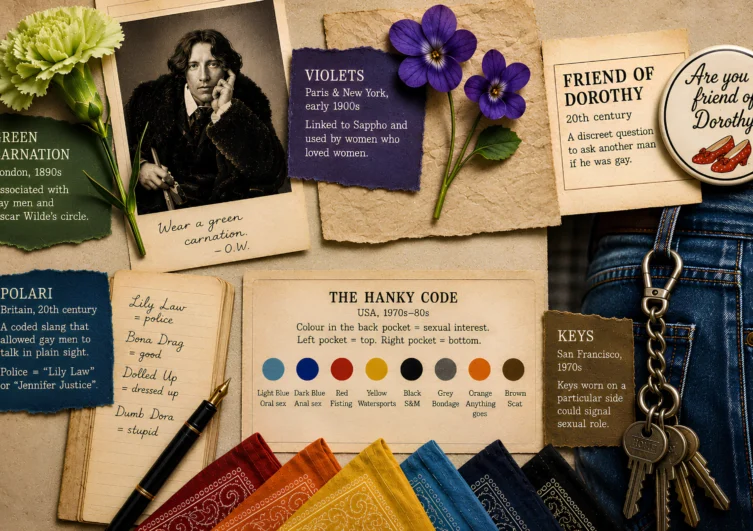
One of the best-known examples dates back to Victorian London. In 1892, Oscar Wilde asked several friends to wear green carnations at the opening night of Lady Windermere’s Fan. The flower subsequently became associated with gay men and with Wilde’s circle, and the association was reinforced by the 1894 novel The Green Carnation. The V&A identifies the green carnation as one of the discreet symbols used by men attracted to men.
There is some debate over whether Wilde actually invented the carnation as a secret homosexual code, so it is safer to say that the flower acquired that meaning around Wilde and his circle, rather than claiming that it had always been a recognised gay signal.
Violets
Women had their own floral language. Violets had long been connected with Sappho and, by the early twentieth century, had become associated with women who loved women. In Paris, lesbians wore violets as a reference to Sappho, while in New York in 1926 women attending The Captive, a play about a woman’s love for another woman, wore violets in solidarity with its subject.
Unlike the green carnation’s association with gay men, the violet therefore became particularly linked with lesbian and Sapphic identity.
Friend of Dorothy
By the twentieth century, the code could be verbal rather than visual. Asking whether someone was “a friend of Dorothy” became a discreet way for gay men to find out whether another man was also gay. The expression could be used without explicitly asking the question that might otherwise put someone at risk.
Its exact origin is uncertain. The most popular explanation connects Dorothy with Judy Garland’s Dorothy in The Wizard of Oz, although other theories exist. What is much better established is that the expression was used as coded language within gay communities.
Polari
In Britain, some gay men went even further and developed a vocabulary that could hide an entire conversation in plain sight.
Polari was a form of slang drawn from several sources, including theatrical and criminal slang, and became particularly associated with gay men in Britain. It allowed people to talk about sex, relationships and other matters without necessarily being understood by those around them. It could also be used to identify people and warn others when police were nearby.
Unlike a flower or a handkerchief, Polari was therefore not simply a way of saying “I’m gay.” It was a practical communication system that helped people navigate a world in which being openly homosexual could have serious consequences.
The Hanky Code
By the 1970s, gay communities in the United States had developed one of the most elaborate visual codes: the hanky code.
A coloured handkerchief worn in the back pocket could communicate a particular sexual interest, while its position indicated sexual role. The usual convention was left pocket for the active/top role and right pocket for the passive/bottom role.
The colours carried the more specific meaning. In commonly documented versions, light blue indicated oral sex, dark blue anal sex, red fisting, yellow watersports, black S&M, grey bondage, orange “anything goes” and brown scat. The precise meanings were not completely universal and changed between communities, but the basic principle was widely recognisable.
The system became particularly associated with gay leather and cruising scenes in cities such as San Francisco and New York. Photographer Hal Fischer documented it in his 1977 project Gay Semiotics, which also examined other visual signals used by gay men, including keys, earrings and clothing.
This was no longer simply a way of recognising another gay person. The code could tell you what that person was looking for.
And that distinction is what makes these historical codes so fascinating: they were not all doing the same job.
Some identified a community. Some signalled attraction. Others communicated sexual preferences or roles. And some allowed people to speak to one another without anyone else realising what they were saying.
Before dating apps could tell people who was gay, who was interested and who was nearby, people had to learn how to read each other.
A flower, a phrase, a colour or a handkerchief could be enough to start the conversation.
Today, we no longer need a green carnation, a violet or a handkerchief in our back pocket to find someone like us. But that doesn’t mean these symbols have lost their meaning.
They are part of a history in which LGBTQ+ people found ways to recognise each other, communicate and create community long before it was safe to do so openly.
So why not bring some of these beautiful pieces of our history back?
Wear a green carnation. Wear a violet. Put a little queer history into the way you dress, even if nobody else knows what it means.
Because sometimes, the best symbols are the ones that carry a story.
One response
[…] the first time. It doesn’t understand the lottery of finding a gay man you actually like whose sexual position is compatible with yours, sparing you the doom of an eternity of sword […]