

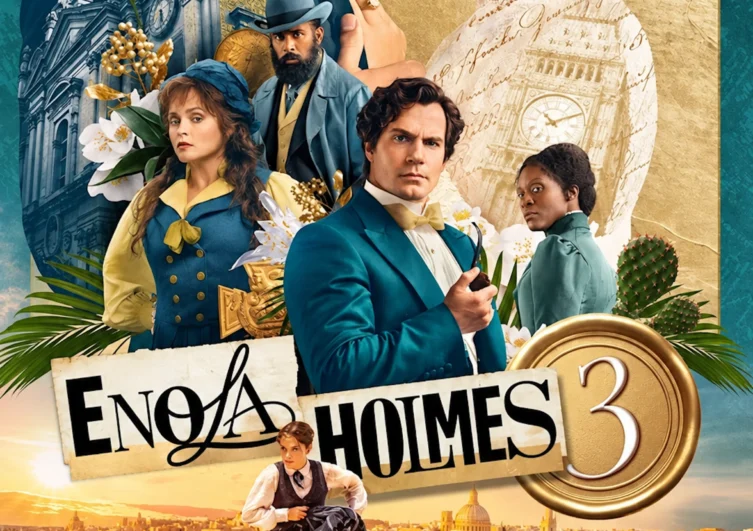
With Enola Holmes 3 now streaming, perhaps it is time to revisit one of the most intriguing relationships in detective fiction: Sherlock Holmes and Dr John Watson. Were they really just friends?
The new Enola Holmes film brings Sherlock and Dr John Watson back together, but their partnership actually has an amusing origin in the Netflix universe. At the end of Enola Holmes 2, Enola arranges an appointment with her brother and then sends Watson in her place. Watson arrives at 221B Baker Street, and that encounter sets up his role as Sherlock’s flatmate and colleague. In the third film, Watson is already firmly part of Sherlock’s world in fact, he is the person who arrives to tell Enola that her brother has been kidnapped.
It is easy to treat the scene as nothing more than a joke. But Enola is supposed to be exceptionally observant, just like her brother. So there is something deliciously appropriate about the idea that she may have looked at Sherlock, looked at Watson and simply thought: these two should live together.
Of course, Arthur Conan Doyle never wrote that Holmes and Watson were lovers. There is no explicit romantic or sexual relationship between them in the original stories. But Doyle did create something rather extraordinary: two men who share a home, a profession, almost every important adventure in their lives and an emotional bond that survives almost everything else.
Watson is not merely Holmes’s sidekick.
He is his closest friend, his chronicler, his travelling companion and, for long periods, his housemate. The stories repeatedly establish how important Watson is to Holmes, while Watson repeatedly chooses Holmes’s company over the more conventional life available to him.
And then there is Mary Morstan.
Watson falls in love with Mary and marries her after the events of The Sign of the Four. The interesting part is what Doyle does with Holmes afterwards. Holmes does not acquire an equivalent romantic relationship. Instead, Watson keeps coming back. The marriage changes Watson’s domestic circumstances, but it never removes him from Holmes’s life.
Doyle even makes Holmes’s own position surprisingly clear. When Watson announces his engagement, Holmes says that he will never marry because romantic emotion would interfere with the cold reasoning he values above everything else. It is a perfectly logical Holmesian explanation but it also leaves him with no romantic partner while Watson remains the person who consistently occupies the other half of his life.
The most revealing moments, however, are not romantic. They are emotional.
In The Adventure of the Three Garridebs, Watson is shot and Holmes believes for a moment that he may have been seriously injured. Watson then describes something extraordinary: Holmes’s usually controlled face changes, his eyes fill with emotion and Watson sees, for once, the “great heart” behind the famous intellect. Watson describes the experience as discovering the depth of Holmes’s “loyalty and love”.
That is not proof that they were lovers. But it is certainly more than the relationship between two interchangeable colleagues.
There is another detail that becomes rather difficult to ignore when reading the stories today: Watson and Holmes actually share a bedroom at times. Baker Street is not simply an office where Watson drops in to discuss cases. It is their home. They eat together, sleep under the same roof, spend their evenings together and frequently disappear on investigations as a pair.
And Watson is not embarrassed by how important Holmes is to him. He describes him as his friend, companion and partner, while the entire structure of the stories depends on their extraordinary closeness.
Then there is the Victorian context. Doyle was writing at a time when sexual relations between men were criminalised in Britain, so modern readers inevitably approach these stories differently from their original audience. That does not prove that Doyle was secretly writing a homosexual relationship there is no evidence that he was but it does make the space between friendship and romance particularly interesting.
The important distinction is between “Doyle wrote them as lovers”, for which there is no evidence, and “Doyle created a relationship that can be read through a queer lens”, which is much harder to dispute.
Perhaps that is why Holmes and Watson continue to generate the question more than a century later. Their relationship is unusually intimate, emotionally intense and central to both men’s lives. Watson gets Mary. Holmes gets Watson. And although that does not make them a couple, it certainly makes their relationship one of the most fascinating friendships in literature.
Which brings us back to Enola.
If the Netflix version of Sherlock is supposed to be as perceptive as his sister, perhaps Enola did not need to know anything about romance. She only needed to notice that her brother was missing something and that John Watson might be exactly the person who could fill that space.
She put them together.
More than a century later, we’re still wondering exactly what she saw.


Leave a Reply