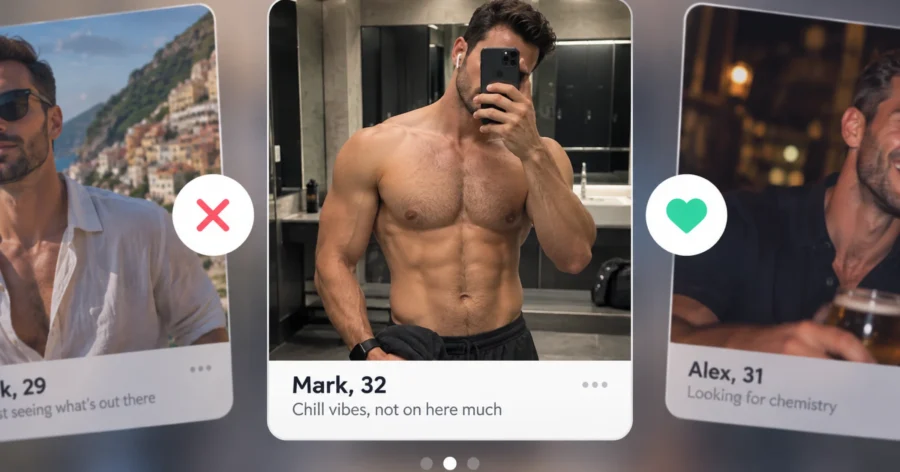
There is a strange thing that happens when you turn 30 as a gay man.
It is not necessarily a crisis. Nothing dramatic happens overnight. You wake up, go to work, meet your friends, scroll through your phone and carry on with your life.
But somewhere along the way, something changes.
Your twenties were probably about figuring out how to be gay. Your thirties can become about figuring out what kind of life you actually want.
And those are two very different questions.
Suddenly, you are no longer the youngest person in the room
For many gay men, their twenties are when they discover the community.
You find the bars, the clubs, the apps, Pride, the friendships, the relationships and all the complicated rules that seem to come with being gay.
There is excitement in it. Everything feels new.
Then you reach your thirties and realise that the gay world has not stopped but your relationship with it has changed.
The clubs you once loved might suddenly feel exhausting. You may still enjoy going out, but perhaps you no longer want an entire weekend to revolve around it.
And then there is the strange experience of seeing younger gay men arrive and recognising yourself in them.
You remember being that age.
You just don’t feel that far away from it.
Dating becomes strangely complicated
Dating in your twenties can be messy because you are still discovering what you want.
Dating in your thirties can be messy because you know what you want and discovering that someone else wants the same thing can be surprisingly difficult.
You become less interested in pretending not to care.
You might not want endless situationships, three-month relationships that go nowhere or conversations that disappear after “Hey, how are you?”
At the same time, knowing what you want does not automatically make finding it easier.
There is a strange contradiction to being single in your thirties: you can be more emotionally mature, more confident and more comfortable with yourself than you were at 22, while simultaneously wondering why finding the right person seems so difficult.
And dating apps do not necessarily make that feeling better.
You can have hundreds of potential people within a few kilometres of you and still feel like you haven’t met anyone.
Your friendships start changing
This might be one of the biggest changes.
At 25, your friends can feel like the centre of your universe.
At 35, everyone’s lives start moving in different directions.
Some friends enter long-term relationships. Some get married. Some move abroad. Some become obsessed with their careers. Some disappear into domestic life.
And suddenly the group chat that used to be full of plans for Friday night is mostly people sending memes and trying to find a date when everyone is actually free.
It isn’t necessarily a bad thing.
It is simply adulthood.
But there can be a particular kind of loneliness in realising that the community you built in your twenties isn’t going to remain exactly the same forever.
You start questioning the gay life you were supposed to want
This may be the strangest part.
For years, you can absorb a very specific idea of what being gay is supposed to look like.
Be attractive.
Go out.
Have sex.
Date.
Travel.
Have an amazing social life.
Stay young.
Be desirable.
Then your thirties arrive and you realise you don’t necessarily want all of that.
Maybe you want a quiet house, a dog, a garden and someone to cook dinner with.
Maybe you want to travel alone.
Maybe you want a career that actually makes you happy.
Maybe you want a relationship.
Maybe you don’t.
And perhaps for the first time, you start asking a much more important question:
What do I actually want, rather than what am I supposed to want?
Your relationship with your body changes
There is also something uncomfortable about growing older in a culture that places an enormous value on youth.
You notice the changes.
Your face changes. Your body changes. Your metabolism changes. The men you once considered “older” suddenly turn out to be your age.
And because gay culture can be intensely visual, it is easy to become preoccupied with whether you are still attractive, desirable or interesting.
But something else can happen too.
You can become much less interested in being attractive to everyone.
At 22, being desired can feel like validation.
At 32, you may start realising that being desired by the wrong people means very little.
That is a surprisingly liberating realisation.
You become more comfortable saying no
One of the best things about your thirties is that you usually know yourself better.
You know which friendships drain you.
You know what kind of relationship you don’t want.
You know which behaviour you will tolerate and which behaviour you won’t.
You become less willing to spend six months trying to convince someone to like you.
You stop explaining yourself quite so much.
And, perhaps most importantly, you start understanding that being single does not mean something has gone wrong.
Your life does not have to look like anybody else’s.
There is still plenty of time
The pressure of turning 30 can make it feel as though you have somehow missed your opportunity.
You haven’t.
Thirty is not the end of your youth. Thirty-five isn’t the end of your desirability. Forty isn’t the end of your gay life.
If anything, your thirties can be the first decade in which you have enough experience to build a life that actually belongs to you.
You have already survived the awkwardness of coming out, the first heartbreaks, the terrible dates, the questionable decisions and at least one person you should definitely never have texted again.
You know more now.
And that matters.
Maybe the strange part is that nobody tells you this
Nobody really prepares you for the transition.
There is plenty of conversation about coming out. Plenty about being a gay teenager. Plenty about dating and sex and Pride.
But there is surprisingly little discussion about what happens afterwards.
What happens when you are no longer discovering your sexuality, but discovering adulthood?
What happens when the gay life you imagined at 20 doesn’t look anything like the life you have at 35?
The answer is that you adapt.
You change.
You lose some people and meet others.
You become less interested in performing a version of gayness for other people and more interested in simply being yourself.
And perhaps that is the real strange experience of being gay in your thirties.
You spend your twenties learning how to be comfortable with being gay.
Then, somewhere in your thirties, you realise that the next challenge is much bigger:
learning how to be comfortable with yourself.