

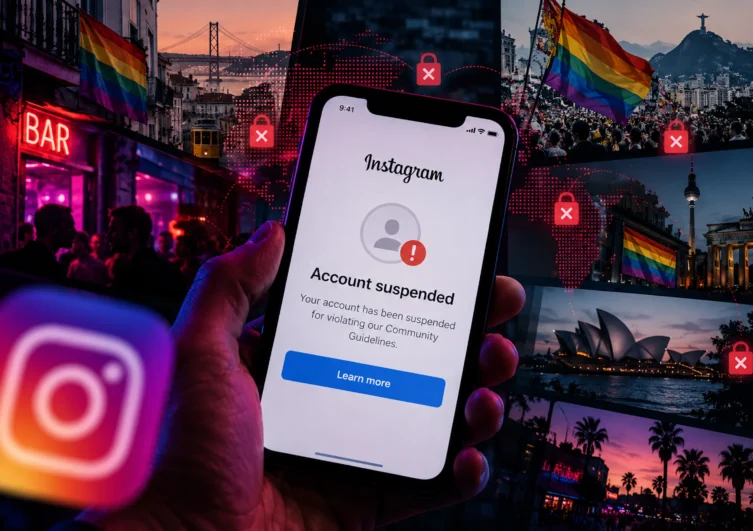
Across the world, LGBTQ+ bars, publications and community groups are reporting suspended Instagram and Facebook accounts. From a week-long wave in Portugal to new cases in the US, their stories raise urgent questions about Meta’s moderation.
Imagine spending ten years building a business, developing relationships with thousands of people and establishing a community that depends on your work.
Then, one morning, you open Instagram.
Your account is gone.
Or perhaps it’s your Facebook page. Maybe your advertising account has been disabled, leaving you unable to promote events or reach customers.
No warning. No meaningful explanation. No conversation with an actual human being.
Just a notification informing you that you’ve apparently broken the rules.
Welcome to an increasingly familiar experience for LGBTQ+ businesses and organisations around the world.
Over the past year, queer venues, independent publications, artists and community groups have reported waves of suspensions affecting their Instagram and Facebook accounts.
The incidents have occurred in countries separated by thousands of miles, sometimes affecting several organisations within days of one another.
Meta has acknowledged mistakes in individual cases. But the wider pattern remains unexplained.
And the consequences extend far beyond losing a few social media followers.
Portugal: when LGBTQ+ accounts disappeared within a week
In September 2025, Portugal experienced a concentrated wave of suspensions affecting accounts connected to the LGBTQ+ community.
The Portuguese LGBTQ+ publication dezanove.pt was among those affected.
Its original Instagram account, which had accumulated approximately 19,000 followers, was suspended on 6 September 2025.
According to the publication, the suspension was not triggered by a specific post on its own account. Instead, the decision was linked to its association with Lisbon Gay Circuit, an LGBTQ+-friendly guide that Meta had identified as violating its rules.
Accounts associated with Lisbon Gay Circuit and Porto Gay Circuit were also affected.
The journalists behind dezanove.pt subsequently investigated complaints received from other LGBTQ+ account administrators, identifying a concentration of suspensions within the space of a week.
The findings were particularly concerning because the affected profiles represented very different activities.
They were not simply accounts promoting sexually explicit material.
They included businesses, entertainers, community projects and organisations providing information to LGBTQ+ audiences.
In an investigation published on 3 October 2025 and subsequently updated, dezanove.pt documented complaints involving Lisbon nightclub Construction, inclusive rugby club Dark Horses, performer Sabrine Mello, cruising venue XXL Lisboa and other businesses and individuals.
Construction had lost an Instagram account with more than 18,000 followers.
Sabrine Mello, a prominent figure in Lisbon’s LGBTQ+ nightlife, reportedly lost access to an account with more than 90,000 followers. A source close to her alleged that the account had received 38,000 reports within 30 minutes, although that figure has not been independently verified.
The publication’s wider investigation also included incidents from earlier periods, demonstrating that the problem was not confined to the September wave.
And importantly, the restrictions were not limited to Instagram.
Proud Portugal, a tourism and events business catering to the LGBTQ+ community, reported that its Facebook page had been targeted by complaints and was no longer visible.
Another affected professional, Massimiliano Trovarelli, associated with Lisbon’s Shelter Bar, reportedly lost both a long-established Facebook page dedicated to homeopathy and an Instagram account.
The publication also documented the difficulties experienced by account administrators attempting to rebuild their audiences on new pages.
For dezanove.pt, the consequences were not merely commercial.
Its Instagram account contained years of LGBTQ+ news, cultural documentation and community history.
Losing access meant losing a public-facing archive of Portuguese LGBTQ+ life.
And Portugal was far from alone.
From Berlin to Bangkok: a problem crossing borders
By the end of 2025, similar accounts were emerging from several countries.
In Germany, Berlin-based queer party collective Gegen reported repeated Instagram removals.
According to an investigation published by Resident Advisor, its account was removed in August 2025 and again in October, following allegations of human exploitation that the organisers rejected.
Accounts belonging to two of the collective’s founders were also reportedly affected.
In France, Paris-based Replicant Events lost eight associated accounts in August 2025.
The collective’s founder said the profiles were eventually recovered following legal intervention and contact with political authorities.
Meanwhile, the LGBTQ+ nightlife collective HORN, in Bangkok, Thailand, reported losing an Instagram account with approximately 8,000 followers.
In Santiago, Chile, queer party organiser Chachorros described losing its online presence shortly before reaching 15,000 followers.
For these businesses, Meta’s platforms were not simply somewhere to share attractive photographs.
They were advertising channels, customer databases, events calendars and connections to their communities.
Losing access could mean cancelled bookings, reduced ticket sales and struggling to reach audiences that had taken years to build.
What initially looked like isolated incidents was becoming an international concern.
The Netherlands: suspended, restored and suspended again
If the Portuguese cases raised questions, what happened in the Netherlands made those questions considerably harder to dismiss.
In December 2025, numerous LGBTQ+ and queer nightlife accounts were suspended.
Some were eventually restored.
Then, in April 2026, several of the same organisations were affected again.
Among those reporting Instagram suspensions were The Queer Agenda, Club Church, gay sauna Nieuwezijds and Amsterdam nightclub Tillatec.
According to Dutch public broadcaster NOS, dozens of accounts were blocked without clear explanations.
Local broadcaster AT5 also documented restrictions affecting accounts across Instagram and Facebook.
The messages received by some account holders suggested that their profiles had been disabled because they were linked to another account accused of violating Meta’s rules.
That detail is particularly significant.
It suggests that, in some cases, the consequences of an alleged violation may extend beyond the account that supposedly committed it.
Even more remarkably, The Queer Agenda reportedly avoided publishing new material after recovering from its previous suspension, only to face another removal.
By 30 April, several Dutch accounts had been reinstated, although others remained inaccessible.
But their recovery raised another question.
If an account can disappear, return and disappear again without a clear explanation, how exactly are administrators supposed to know what they have done wrong?
And how can they prevent it from happening again?
Brazil: more than 100 LGBTQ+ profiles reported blocked
In Brazil, the situation became serious enough to attract the attention of federal prosecutors.
On 3 June 2026, the country’s Federal Public Prosecutor’s Office announced that it had demanded explanations from Meta following a complaint about the suspension of more than 100 LGBTQ+ Instagram profiles.
According to the complaint submitted by Sleeping Giants Brasil, the affected accounts collectively represented an audience of more than 1.7 million followers.
The suspensions reportedly occurred between May and June, including periods close to the International Day Against Homophobia, Biphobia and Transphobia and São Paulo’s Pride celebrations.
The affected profiles included media outlets, content creators and organisations involved in LGBTQ+ rights and public information.
The prosecutors sought information about the rules allegedly violated, the possible use of automated moderation and whether coordinated mass-reporting campaigns could have contributed to the removals.
These were questions under investigation, not established findings.
Nevertheless, the case marked an important development.
The controversy had moved beyond individual businesses complaining about lost accounts.
A public authority was formally demanding answers.
And the fact that the complaints concerned more than 100 LGBTQ+ profiles made the scale of the allegations difficult to ignore.
Australia: Facebook pages, Instagram accounts and advertising access disappear
Australia has also experienced a substantial number of reported suspensions.
In July 2026, QNews reported that five LGBTQ+ venues in Sydney and Melbourne had experienced restrictions affecting their Facebook or Instagram accounts.
The establishments included The Laird, The 86, Palms on Oxford, UBQ and Tribe @ 231.
The cases demonstrated how differently Meta’s restrictions could affect businesses.
The Laird, a well-known Melbourne gay venue, eventually recovered access to its Facebook page after several appeals, but its Instagram account was deactivated.
At UBQ, another Melbourne establishment, administrators discovered that their Facebook and Instagram accounts had been disconnected. Their Facebook page was subsequently restricted, with notices referring to content allegedly involving drugs and weapons.
The venue disputed the implications of those warnings.
At The 86, both business and personal Facebook accounts were reportedly disabled.
Meanwhile, Palms on Oxford and Tribe @ 231, two Sydney venues, experienced restrictions affecting their social media operations within a short period.
For businesses that rely heavily on Facebook events, Instagram posts and paid advertising, the damage can be immediate.
Some began rebuilding their websites and mailing lists to reduce their dependence on Meta.
By August, digital-rights organisation Repro Uncensored had documented more than 70 Australian cases involving account suspensions, removals or restrictions.
Importantly, those cases were not exclusively LGBTQ+ accounts. The organisation also documented restrictions involving artists, racialised communities and public-health projects.
Nevertheless, the diversity of affected LGBTQ+ organisations raises an obvious question.
If the problem is supposedly inappropriate sexual content, why are ordinary community activities also getting caught in the moderation system?
Los Angeles: a Facebook page disappears, and business suffers
The situation in California provides one of the clearest examples of why focusing exclusively on Instagram would miss part of the story.
Catch One, a historic Los Angeles nightlife venue founded as a club for Black lesbians, lost its Facebook page and access to Meta’s advertising tools in May 2026.
According to an investigation by the Los Angeles Times, the venue struggled for months to obtain an explanation or recover access.
Its owner said the restrictions had seriously affected the business’s ability to promote events and sell tickets.
The Facebook page was finally restored on 10 September, following an appeal and intervention by a California lawmaker.
Another Los Angeles gay venue, Club Tempo, also lost its Facebook page while retaining its Instagram account.
Meanwhile, the city’s LGBTQ+ nightlife community experienced a series of Instagram suspensions.
Club Cobra, a long-established Latino gay nightclub in North Hollywood, lost its Instagram account on New Year’s Day 2026.
Accounts associated with other venues and promoters were also affected.
After months of unsuccessful attempts to recover access, several profiles were restored in September, around the time the Los Angeles Times investigated the incidents.
The cases illustrate something particularly troubling about Meta’s interconnected platforms.
A business might lose Instagram while keeping Facebook.
Another might lose Facebook but retain Instagram.
And some may also lose access to the advertising infrastructure that connects both services.
For small businesses, these distinctions matter less than the consequences.
They are paying to reach customers through a commercial platform that can suddenly become inaccessible.
Oakland and Orlando: the suspensions are still happening
More than a year after the Portuguese wave, fresh cases continue to emerge across the United States.
On 26 October 2026, the Bay Area Reporter documented restrictions affecting social media accounts belonging to two Latino LGBTQ+ clubs in Oakland, California.
Que Rico and Next Level lost access to Instagram and Facebook accounts on 30 September, according to owner Valentino Carrillo.
The businesses’ accounts were managed through a connected Facebook page, Valentino Presents, which also became inaccessible.
Carrillo described difficulties recovering access despite submitting identification documents and attempting to follow Meta’s appeal procedures.
He also reported that the loss of online visibility was affecting business, particularly on Fridays.
The same investigation described a new case involving Anthem Orlando, an LGBTQ+ nightclub in Florida.
Its Instagram account was suspended on 19 October, two days after the city’s Pride celebrations and the venue’s first anniversary.
The owners said their appeal was rejected without being told which publication or rule had caused the suspension.
They created a new Instagram account and began rebuilding their audience.
In San Francisco, meanwhile, gay nightclub Beaux had its Instagram account suspended in September before eventually regaining access.
In that case, Meta acknowledged that the removal had been a mistake.
It was an important admission.
But it did not explain why similar incidents continued to be reported by LGBTQ+ businesses elsewhere.
Is Meta deliberately targeting LGBTQ+ accounts?
This is where the story becomes more complicated.
The number and geographical spread of reported incidents raise legitimate concerns about disproportionate effects on LGBTQ+ communities.
But a pattern of complaints is not, by itself, proof of deliberate discrimination.
There are several possible explanations.
Automated moderation systems may incorrectly classify LGBTQ+ content, particularly material involving nightlife, sexuality, fetish culture or health education.
Coordinated reporting by hostile individuals or groups could potentially contribute to reviews or restrictions.
And account-linking mechanisms may allow problems associated with one profile to affect others managed by the same people or organisations.
These possibilities deserve investigation.
However, the available public evidence does not establish that every case has the same cause or that Meta has implemented a coordinated policy to remove LGBTQ+ accounts.
Meta has acknowledged that its moderation systems make mistakes and points to appeal mechanisms as a way to correct wrongful decisions.
Yet affected organisations frequently describe those mechanisms as difficult to navigate, slow or unhelpful.
In some cases, accounts have been restored without the owners receiving a detailed explanation of what caused the original suspension.
In others, administrators say they cannot even establish which publication supposedly violated the rules.
And the latest cases suggest that the problem has not disappeared.
The question is therefore not simply whether Facebook and Instagram make mistakes.
Of course they do.
The question is whether their systems are making certain communities pay a disproportionately high price for those mistakes.
And whether Meta is doing enough to find out.
More than 600 cases documented worldwide
The international dimension is becoming increasingly difficult to overlook.
According to Repro Uncensored, reports of account restrictions documented by the organisation increased from approximately 50 in December 2025 to more than 600 by August 2026.
That figure covers multiple forms of platform restrictions and communities beyond LGBTQ+ organisations.
It should not be interpreted as 600 confirmed discriminatory removals of LGBTQ+ accounts.
Still, it provides an indication of the scale of complaints being documented by digital-rights advocates.
The European Union has already established transparency and appeal requirements through its Digital Services Act.
Under the legislation, platforms must provide reasons for covered content and account restrictions, as well as mechanisms through which affected users can challenge decisions.
For LGBTQ+ organisations that have received little more than automated notifications, those rights are especially relevant.
But legislation alone cannot immediately restore years of photographs, conversations, historical records and relationships when account holders remain locked out.
Who owns a community’s digital history?
Perhaps the most disturbing aspect of this story is how much power private platforms can exercise over public life.
For LGBTQ+ communities, Facebook and Instagram have become considerably more than entertainment.
They are where people discover safe spaces, access sexual-health information, organise events, find support and document their history.
For independent LGBTQ+ publications, these accounts can also function as public archives.
The disappearance of a nightclub’s page can damage a business.
The disappearance of an LGBTQ+ media account can cut off access to years of community reporting.
And the loss of an organisation’s profile can make vital services harder to find.
From Lisbon to Amsterdam, São Paulo, Sydney and Los Angeles, the complaints share a common feature: people have built communities on platforms where the rules governing their continued existence can feel invisible.
There is still no conclusive evidence of a single coordinated campaign behind all these suspensions.
But there is substantial evidence of recurring removals, inconsistent recoveries, inadequate explanations and serious consequences for the organisations affected.
That should be enough to demand meaningful answers.
Because when one LGBTQ+ account disappears, it might be an error. When communities across several continents keep reporting the same experience, the problem deserves more than another automated rejection.
And until Meta can explain what is happening, the question remains:
Who gets to decide which communities are allowed to exist online?
Leave a Reply