

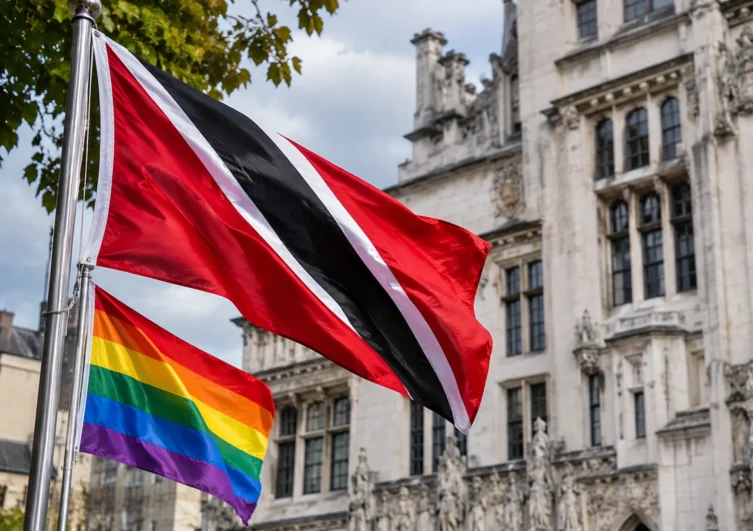
Trinidad and Tobago has achieved a historic victory for LGBTQ+ rights after the country’s highest court of appeal ruled that laws criminalizing consensual same-sex relations are unconstitutional. The landmark decision, delivered on 10 November 2026, ends a lengthy legal battle and marks another significant step towards decriminalisation across the Caribbean.
The ruling was issued unanimously by the Judicial Committee of the Privy Council in London, which serves as Trinidad and Tobago’s final court of appeal. All five judges agreed that provisions of the country’s Sexual Offences Act of 1986 violated fundamental constitutional rights, particularly the right to respect for private and family life.
The legislation criminalised certain sexual acts between consenting adults of the same sex, carrying prison sentences of up to five years. Although the provisions had rarely been enforced in recent years, their existence continued to contribute to stigma and discrimination against LGBTQ+ people.
A Legal Battle Spanning Nearly a Decade
At the centre of the case was Jason Jones, a Trinidadian-born LGBTQ+ activist who began challenging the legislation in 2017. Jones initially secured a victory in 2018 when the High Court declared the discriminatory provisions unconstitutional. However, the government challenged that decision, and the Court of Appeal partially reversed it in 2025.
Unwilling to abandon the fight, Jones took his case to the Privy Council, arguing that criminalising consensual same-sex intimacy violated constitutional protections and treated LGBTQ+ citizens as unequal under the law.
The judges ultimately sided with Jones, rejecting the government’s arguments and confirming that the constitutional right to private and family life protects sexual orientation as an essential aspect of personal identity.
The Legacy of Colonial-Era Legislation
The ruling also addressed the legacy of British colonial legislation, which introduced criminal prohibitions against same-sex intimacy across numerous Caribbean territories. Despite gaining independence, several countries retained these laws for decades.
Human Rights Watch welcomed the decision, describing it as an important development in the wider movement to dismantle discriminatory legislation inherited from colonial rule.
The organisation emphasised that decriminalisation is a fundamental human rights issue rather than a special privilege, and called on governments that continue to criminalise consensual same-sex relations to repeal such provisions.
A Landmark Decision for the Caribbean
The decision follows similar legal victories in Caribbean countries including Barbados, Dominica and Saint Lucia, where courts have also struck down laws targeting consensual same-sex intimacy.
Nevertheless, criminalisation remains a reality in several countries across the region, including Jamaica, Grenada and Saint Vincent and the Grenadines.
For Trinidad and Tobago, the judgment represents a decisive legal breakthrough, although LGBTQ+ advocates acknowledge that further progress is needed to address discrimination, strengthen legal protections and achieve broader equality.
The Privy Council’s decision is final and cannot be appealed. While the court has left the precise form of the legal remedy open to further written submissions, its conclusion that consensual same-sex intimacy cannot constitutionally be criminalised is definitive.
For Jason Jones and the country’s LGBTQ+ community, the ruling closes a significant chapter in the struggle for legal recognition while opening the door to further advances in equality and human rights.

Leave a Reply