

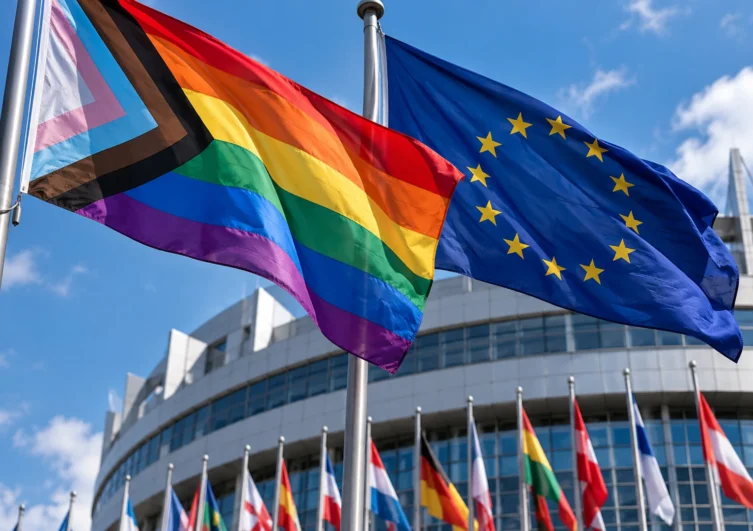
The Council of Europe has adopted its first-ever Strategy for Equal Rights for LGBTI People, establishing a common framework for protecting the rights of lesbian, gay, bisexual, transgender and intersex people across Europe between 2027 and 2032.
Adopted by the Committee of Ministers on 23 September in Strasbourg, the strategy comes more than four decades after the European Court of Human Rights issued its first judgment concerning LGBTI rights in 1981. The Council of Europe says the new framework is intended to bring together decades of legal standards and make their implementation more consistent across its member states.
But the document arrives at a complicated moment for LGBTI people in Europe. While legal protections have expanded in many countries, the Council of Europe acknowledges that progress remains uneven, with discrimination, hate speech, hate crimes and violence continuing to affect LGBTI communities.
The strategy identifies four priorities for the next six years: strengthening recognition of the equal rights and dignity of LGBTI people; countering disinformation and manipulation targeting LGBTI communities; preventing and combating hatred and violence; and strengthening legal and institutional protections.
From rights on paper to rights in practice
One of the most significant aspects of the strategy is that it does not present equality simply as a question of passing new legislation.
Instead, it focuses heavily on implementation.
The Council of Europe says its work will cover areas including private and family life, hate speech and hate crime, education, employment, healthcare, public services and support for victims. Civil society participation and the impact of digital technologies and artificial intelligence are also explicitly included.
That last point reflects an increasingly important part of the European debate. The Council of Europe warns that artificial intelligence and digital technologies can reproduce existing biases, facilitate intrusive surveillance and technology-enabled violence, and accelerate the distribution of harmful content.
For LGBTI people, the strategy therefore extends beyond traditional questions of legal recognition. It also addresses the increasingly digital environment in which discrimination, misinformation and harassment can spread.
A response to a changing European landscape
The Council of Europe says polarising narratives and disinformation increasingly target LGBTI people and can undermine democratic values.
That concern is reflected in one of the strategy’s four central priorities: countering misinformation and manipulation concerning LGBTI people.
The organisation is also placing particular emphasis on hate speech and violence. On the same day the strategy was adopted, the Council of Europe published a report examining anti-LGBTI hate speech across its member states and identifying gaps between existing commitments and protection in practice.
The strategy takes an intersectional approach, recognising that discrimination based on sexual orientation, gender identity, gender expression or sex characteristics can overlap with other forms of inequality, including racism, sexism and ableism.
What happens next?
The strategy itself does not automatically change national laws.
Its implementation will depend significantly on individual member states. The Council of Europe says it will support governments through legal and policy expertise, technical assistance, monitoring, training and exchanges of good practice.
Implementation will be coordinated through the Council of Europe’s Committee of Experts on Sexual Orientation, Gender Identity and Expression and Sex Characteristics, together with other relevant bodies.
The strategy is scheduled to be officially launched on 26 January 2027, during the Montenegrin Presidency of the Committee of Ministers.
That leaves European governments with six years to turn the framework into concrete action.
For LGBTI communities across Europe, the significance of the announcement may ultimately depend less on the language of the strategy than on what happens when those commitments meet national politics, courts, public institutions and everyday life.
The Council of Europe has now set out its direction.
The next test will be implementation.


Leave a Reply