

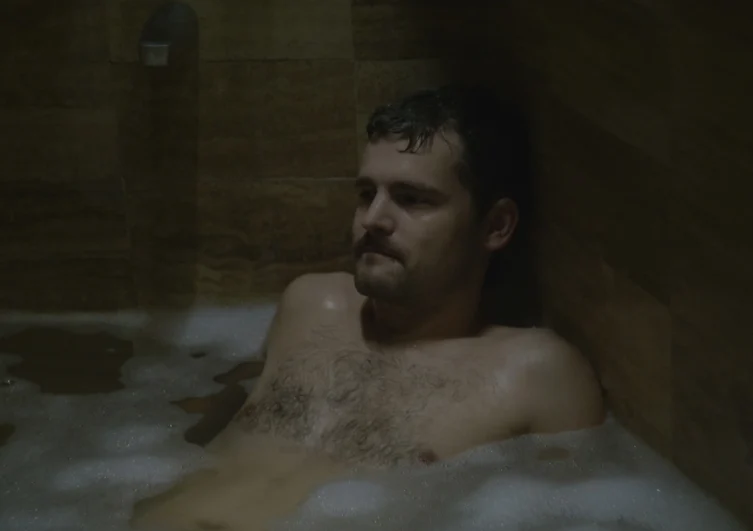
Being gay and single can be exhausting. The endless dating apps, disappointing hookups and men who disappear without explanation. But imagine being a vampire whose family expects him to seduce men and bring them home to be murdered. That’s the rather unfortunate existence at the centre of Time to Go, an Argentine queer horror comedy that proves even immortality can’t save you from a terrible love life.
We’ve all heard stories about dates from hell. The man who spends two hours talking about his ex. The one whose profile picture is suspiciously ten years old. Or the charming stranger who turns out to have an alarming collection of red flags.
But Patricio has a slightly more unusual problem.
He’s a vampire. He’s gay. He’s depressed. And his family has expectations.
Some families want their sons to become doctors. Others would be delighted with a respectable husband and a mortgage.
Patricio’s sisters have rather different priorities.
And apparently, finding a boyfriend who doesn’t end up dead is asking a little too much.
Meet Patricio, the world’s most exhausted vampire
Directed by Argentine filmmaker Renzo Cozza, Time to Go (La hora de irse) is a 20-minute short film starring Martín Shanly as Patricio, a queer vampire trapped in a life that no longer makes him happy.
He lives with his two demanding sisters, for whom he is expected to find male victims.
His routine involves dating apps, seduction, sexual encounters and murder.
It’s essentially the modern gay dating experience, with a significantly higher body count.
But there’s a problem.
Patricio is tired of it all.
The endless cycle of attracting men, bringing them home and fulfilling his family’s expectations has left him emotionally exhausted.
What he actually wants is something rather ordinary: affection, independence and the possibility of a meaningful relationship.
Unfortunately, becoming emotionally available is difficult enough without having to explain that your family considers your dates dinner.
What happens when a vampire catches feelings?
Everything begins to change when Patricio encounters a mysterious stranger.
Suddenly, the possibility of escaping his monotonous existence seems real.
The attraction offers something that his previous encounters have failed to provide: the prospect of genuine human connection.
But this is a horror film, not a romantic comedy.
And when desire enters the picture, things become increasingly dangerous.
Without revealing the ending, Time to Go turns an apparently simple encounter into a strange, darkly comic exploration of intimacy, control and the possibility of starting again.
It also raises a question that many people, vampire or otherwise, might recognise.
What happens when the life you’ve built becomes the very thing preventing you from living?
Finally, a gay vampire with actual problems
Vampires have been associated with sexuality for generations.
They’re mysterious, seductive, immortal and frequently dressed as though they’ve never recovered from a particularly dramatic nineteenth-century breakup.
They also have a long history of representing forbidden desire, making them an obvious subject for queer interpretations.
But Patricio is a rather different kind of supernatural creature.
He’s not particularly interested in conquering the world, accumulating centuries of wealth or spending eternity looking impossibly attractive in candlelight.
He wants to get away from his family and have a decent relationship.
Which, depending on your experiences with modern dating, might actually be the more ambitious objective.
What makes Time to Go interesting is precisely this contrast between the extraordinary and the painfully ordinary.
The protagonist might drink blood, but his frustrations are recognisably human.
He’s stuck in a suffocating domestic arrangement, repeating behaviours that no longer satisfy him and struggling to imagine an alternative.
The vampire becomes less a terrifying monster and more a man experiencing an exceptionally unusual quarter-life crisis.
With fangs.
Gay horror deserves to be this weird
Queer cinema has often explored exclusion, discrimination, coming out and the struggle for acceptance.
These stories remain important, but there’s something refreshing about LGBTQ+ characters being allowed to inhabit completely different kinds of narratives.
They can be selfish, ridiculous, dangerous, emotionally unstable or simply terrible at making decisions.
They can also be vampires.
And their sexuality doesn’t always need to be the central tragedy.
In Time to Go, being gay isn’t presented as Patricio’s fundamental problem.
His problem is that his entire existence has become unbearable.
It’s an amusing distinction, particularly in a genre that has so frequently used queer desire as a metaphor for monstrosity.
Here, the monster is looking for something profoundly human.
Perhaps that’s what makes the story so appealing.
Even the undead would apparently prefer emotional stability to another meaningless hookup.
An Argentine queer horror story travelling the festival circuit
Released in 2026, Time to Go has appeared at several international film festivals, including the Berlin International Film Festival, New Directors/New Films in New York and the Buenos Aires International Festival of Independent Cinema.
The film also reached Portuguese audiences during the 30th edition of Queer Lisboa, where it screened on 20 September as part of the short-film competition.
Directed and written by Renzo Cozza, the production also features Jerónimo Bosia, Paula Grinszpan, Pilar Viñes and Julián Larquier Tellarini.
Combining fantasy, queer sexuality, mystery and dark comedy, the film transforms a familiar horror figure into a surprisingly relatable protagonist.
And at just 20 minutes, it manages to explore an impressive number of uncomfortable subjects.
Family obligations. Loneliness. Sexual desire. Emotional exhaustion.
And the unfortunate consequences of inviting the wrong man home.
The gay vampire we didn’t know we needed
With Halloween approaching, Time to Go offers something different from the usual collection of possessed dolls, haunted houses and masked serial killers.
It’s strange, sexually charged, darkly funny and unexpectedly interested in the emotional difficulties of being alive.
Or, in Patricio’s case, not entirely alive.
Beneath the supernatural premise is a familiar story about wanting to escape expectations and find something more meaningful.
Because after enough disappointing encounters, even a vampire might start to wonder whether eternal life is really worth the trouble.
And if dating is already a nightmare when you’re mortal, imagine having to do it forever.
Time to Go is available to watch online through The New Yorker’s Screening Room. The short film contains adult sexual content and violence.
Image: Martín Shanly
La hora de irse | Time to Go
© Esquimal Cine, Aurora Cine, Febrero Cine, Florencia Clérico



Leave a Reply