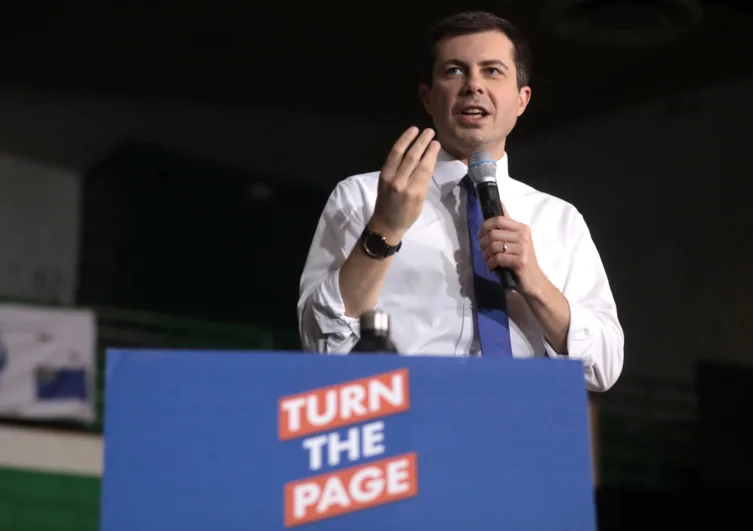
Pete Buttigieg has not announced a 2028 campaign. But if he became the Democratic nominee—and ultimately president—his family’s arrival at the White House would mark a historic change in American political life.
For most of American history, the idea of an openly gay president belonged more comfortably to fiction than to political forecasting. Today, it is still hypothetical—but no longer unimaginable.
Pete Buttigieg, the former mayor of South Bend and former US transportation secretary, remains one of the country’s most recognisable Democratic figures. He has not declared a campaign for 2028. When asked about the possibility in January 2026, he answered, “I don’t know,” and more recent reporting has noted that he has not ruled out another presidential run.
That uncertainty leaves space for a serious political thought experiment. What would America—and the world—look like if Buttigieg ran, won and became the first openly gay president of the United States?
From “Mayor Pete” to the national stage
Buttigieg’s path already contains several firsts. In 2020, he became the first openly gay presidential candidate to win delegates in a major party’s nomination contest. In 2021, the Senate confirmed him as transportation secretary, making him the first openly gay person confirmed to a Cabinet position.
His political appeal has rarely depended on a single identity. Supporters see a veteran, a former Midwestern mayor and an unusually disciplined communicator who can translate progressive goals into moderate language. Critics point to the limitations of his mayoral record, his relationship with Black voters during the 2020 campaign and disputes over his performance at the Department of Transportation. A future campaign would have to answer those criticisms rather than relying on symbolism.
Yet symbolism would matter. The presidency is not only an administrative position. It is also a national mirror. The person who occupies the White House tells citizens—and observers abroad—whose life is considered compatible with American authority.
The first same-sex First Family
If Pete Buttigieg entered the White House with his husband, Chasten, and their children, the visual impact would be immediate. Americans would see two fathers at state dinners, holiday ceremonies, school events and the countless domestic rituals through which presidents present themselves to the public.
For LGBTQ+ families, that visibility could be deeply personal. Children who have two mothers or two fathers would see a family resembling their own at the symbolic centre of American life. Same-sex couples who spent decades being told that their relationships were incompatible with family values would watch those same relationships represented as part of the nation’s official family.
It would also test whether the country could resist turning every ordinary family moment into a referendum on sexuality. The most meaningful development would not be endless celebration of novelty. It would be the gradual normality of it all.
The campaign would test America first
Before any inauguration, a Buttigieg campaign would expose the country’s unresolved attitudes toward gay leadership. His marriage, children and faith would receive scrutiny that heterosexual candidates rarely face. Opponents could use coded language about “traditional values,” while more openly hostile voices would treat his family as a political target.
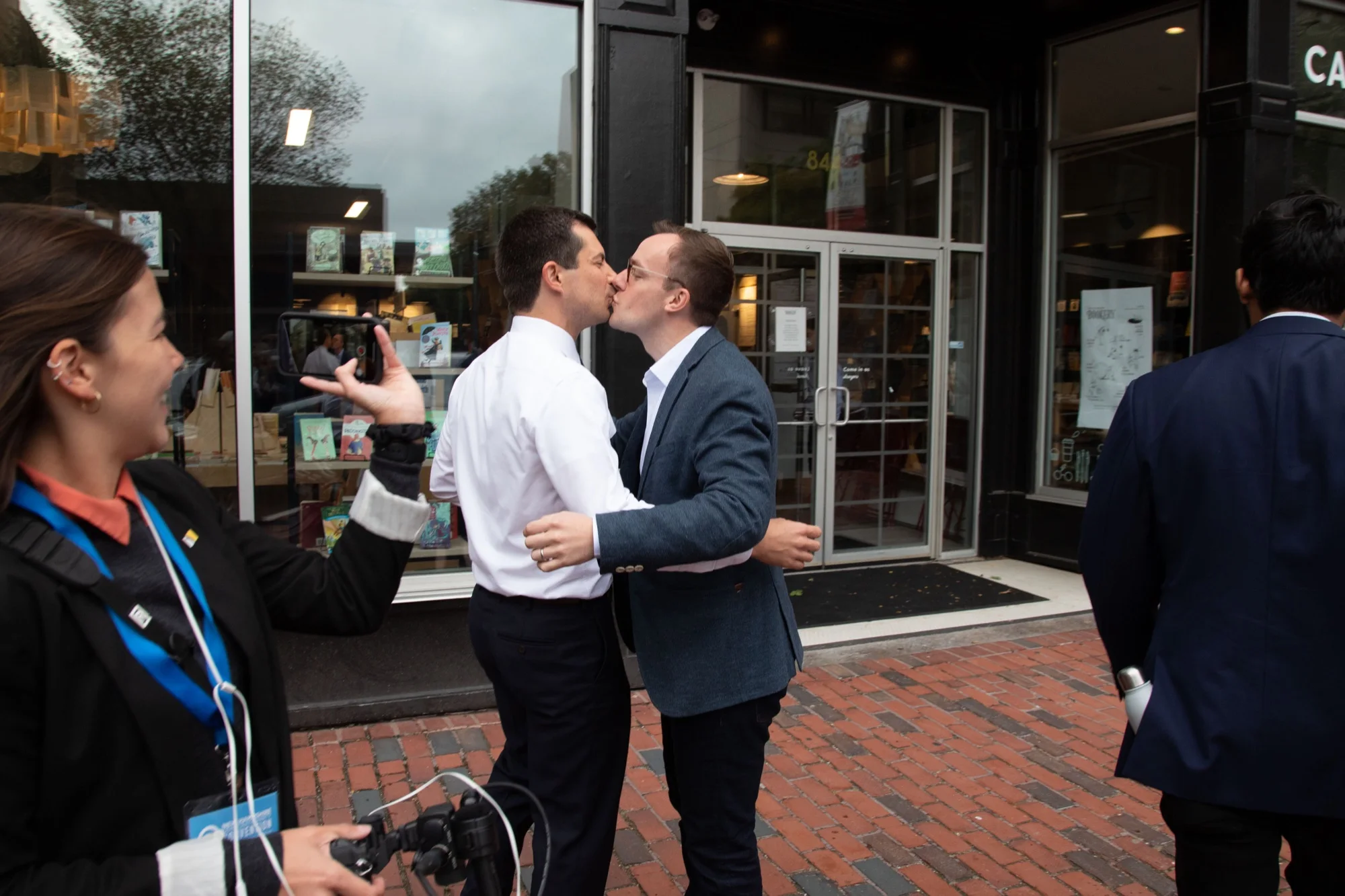
That campaign would reveal how much of America’s acceptance is durable and how much remains conditional. Polling may show growing comfort with LGBTQ+ people in public life, but a presidential race concentrates fear, misinformation and cultural resentment on a single person.
Winning despite that pressure would not end homophobia. It would, however, establish that openly gay identity was no longer an automatic disqualification from the country’s highest office.
A gay president would not automatically protect every LGBTQ+ person
Representation is powerful, but it is not policy. A Buttigieg presidency would be judged by what it did for LGBTQ+ people whose lives differ greatly from his own: transgender Americans, queer people of colour, young people without supportive families, low-income couples and those living in states where legal protections remain fragile.
His 2020 LGBTQ+ policy platform supported federal nondiscrimination protections, stronger responses to violence against transgender people, limits on conversion therapy and broader access to healthcare. Any future platform would need to address a political landscape that has become even more hostile to transgender rights in many states.
The historic identity of a president should never become a shield against criticism. Electing the first gay president would be a milestone. Protecting the most vulnerable members of the LGBTQ+ community would be the measure of whether that milestone produced meaningful change.
Representation would meet the limits of presidential power
No president governs alone. Congress writes laws, courts determine their reach and state governments control many of the policies that shape daily life. Even a strongly supportive administration could face resistance over employment protections, education, healthcare, family recognition and transgender rights.
A Buttigieg administration could use executive authority to enforce federal civil-rights rules, appoint LGBTQ+-inclusive judges and officials, defend vulnerable communities in court and restore diplomatic attention to human rights. Lasting reform, however, would still require legislation and public support.
That distinction matters because representation can create unrealistic expectations. A gay president could change the emotional meaning of the office overnight. Changing the legal and material conditions of millions of lives would take longer.
More than an LGBTQ+ presidency
Buttigieg could not build a successful presidency around identity alone. Voters would expect answers on the cost of living, housing, healthcare, climate change, migration, foreign policy and the future of work. His time overseeing the Department of Transportation would inevitably form part of that evaluation, both as evidence of executive experience and as a record open to criticism.
That may be one of the healthiest aspects of the hypothetical. An openly gay candidate seeking the presidency would have to be treated as a complete political figure—capable of inspiration, compromise, achievement and failure. Equality includes the right to be judged on the full substance of one’s record.
What it could mean beyond America
The consequences would extend beyond US borders. A same-sex couple representing the United States at summits and state visits would be welcomed in some countries and condemned in others. Their presence could challenge governments that criminalise homosexuality or use LGBTQ+ people as political scapegoats.
For queer people living under repression, the image of an openly gay American president would carry undeniable symbolic weight. It could offer hope, but it could also provoke backlash. US diplomacy would need to support local activists carefully, without pretending that American visibility alone can transform another society.
Could America recover some moral authority?
American governments frequently speak about freedom and human rights abroad while struggling to protect both at home. Electing an openly gay president would not erase that contradiction. It could nevertheless strengthen the credibility of diplomats challenging laws that criminalise same-sex relationships or suppress LGBTQ+ organisations.
The strongest message would not be that America had solved prejudice. It would be that democratic societies can change, and that people once pushed outside public life can eventually help lead it.
What his election would—and would not—mean
A Buttigieg victory would not prove that homophobia had disappeared. Barack Obama’s election did not end racism, and the election of a gay president would not end anti-LGBTQ+ discrimination. Political breakthroughs can exist alongside renewed hostility.
It would still alter the boundaries of political possibility. Future LGBTQ+ candidates would no longer need to persuade voters that someone like them could become president. That question would already have been answered.
“The breakthrough would not be that a gay man had somehow become exceptional enough to enter the White House. It would be that America had finally accepted his family as unexceptional enough to belong there.”
— Michael Cabral
The morning after history
The most revealing moment might arrive after the celebration. A gay president would wake in the White House, receive a security briefing, confront a divided Congress and begin making choices that pleased some supporters and disappointed others. His children would go to school. His husband would develop a public role. The machinery of government would continue.
That ordinariness would be part of the achievement. The United States would not suddenly become perfect, and the world would not stop turning because two men and their children called the White House home.
History would have happened—and then life would continue.
Editor’s note: This article is a political thought experiment. As of August 2026, Pete Buttigieg has not announced a campaign for the 2028 presidential election.