


Hanya Yanagihara’s A Little Life is the worst book I’ve ever read — not because it’s badly written, but because it left me emotionally battered and somehow still unable to put it down.
Spoiler warning: This review discusses some of the novel’s major themes, relationships and events. I’ve deliberately avoided revealing how the story ultimately ends, but if you want to go into A Little Life knowing absolutely nothing, read the book first.
There are books you finish and immediately recommend to everyone you know. There are books you finish and forget about a few weeks later. And then there is A Little Life.
I finished Hanya Yanagihara’s novel feeling almost angry at it, exhausted by it and emotionally battered by it. If someone asked me whether I enjoyed reading A Little Life, the answer would be an immediate and emphatic no.
It may genuinely be the worst book I have ever read.
And I don’t mean that it is badly written. Quite the opposite. I mean it was one of the worst experiences I have ever willingly subjected myself to for hundreds upon hundreds of pages — and somehow, despite everything, I could not stop reading.
Because throughout the entire book, one thought kept pulling me forward: surely, eventually, there has to be a light at the end of the tunnel.
That question becomes almost addictive. How much can happen to one person? How much can someone endure? And after hundreds of pages of pain, friendship, love, success, trauma and survival, where exactly is Yanagihara taking us? I needed to know.
Four Men, One Friendship — And a Very Queer World
A Little Life begins as the story of four college friends — Jude, Willem, JB and Malcolm — making their way into adulthood in New York. At first, I assumed I was settling into one of those enormous, decades-spanning, almost Martin Scorsese-style stories about friendship: careers, relationships, ambition, jealousy and the strange ways people grow together and apart.
And for a gay publication like Chronicle 19, there is an immediate familiarity to the world these men inhabit. Queerness is woven through the novel rather than treated as a single issue to be confronted and resolved.
JB is openly gay. Jude’s sexuality and relationship with intimacy become enormously important to the story. Willem’s romantic life does not fit neatly into a simple label. Male friendship frequently crosses into territory that is more intimate, emotionally dependent and complicated than the traditional boundaries of heterosexual male friendship usually allow. Eventually, some of those friendships become something more.
What I particularly appreciated is that A Little Life doesn’t build its queer characters around the usual coming-out narrative. Being gay is not the great dramatic revelation. There is no single scene in which homosexuality suddenly becomes the problem everyone must deal with. These men simply live in a world where men can love men.
For gay readers, there is something almost refreshing about that. Unfortunately, everything else about the book is considerably less relaxing.
And Then There Is Jude
Very quickly, the novel’s centre of gravity begins to shift. The others remain important, but increasingly this becomes Jude St. Francis’s story.
Jude is brilliant, successful, kind and intensely private. He also lives with chronic pain, has difficulty walking and refuses to speak about his childhood. There are things his closest friends simply don’t know about him.
We know something terrible has happened. We just don’t know how terrible.
Yanagihara reveals Jude’s past gradually, which is one of the reasons I found the book so difficult to put down. You receive a fragment, then another, then something worse. Underneath every revelation appears to be another locked door.
You start reading partly because you care about Jude and partly because you need to understand him. Why does he believe the things he believes about himself? Why is love so difficult for him to accept? Why can someone so clearly valued by the people around him remain convinced that he has almost no value at all? The answers are devastating.
When Sex and Love Become Almost Impossible to Separate
This is also where A Little Life becomes particularly complicated as a queer novel. Jude’s relationship with sex is inseparable from trauma. Much of the abuse he experienced involved men, and that shapes the way he understands his own body, desire and relationships for the rest of his life.
For him, male intimacy has been associated with both extraordinary cruelty and extraordinary tenderness. That contradiction runs throughout the novel: men hurt Jude, men exploit Jude, but men also become the people who love him most deeply.
That makes his relationship with queerness far more complicated than a straightforward gay love story, and I think gay readers may respond to that part of the book in wildly different ways.
On one hand, there is something powerful in the sheer amount of emotional space Yanagihara gives relationships between men. These men touch one another, care for one another, worry about one another, depend on one another and love one another. Their friendships are not emotionally constipated caricatures of masculinity.
Chosen family matters enormously, and anyone who grew up queer will probably understand why that idea can carry such emotional weight. For many gay people, the family you build becomes every bit as important as the one you were born into. A Little Life understands that instinctively.
But the book also places gay male sexuality alongside some extremely dark material, and that made me uncomfortable at times. Not because difficult or abusive gay relationships shouldn’t appear in fiction — of course they should — but because the sheer concentration of sexual trauma surrounding Jude can become overwhelming. Sometimes I found myself wondering whether I was reading an exploration of trauma or simply watching an author continually invent new ways to traumatise the same character.
As an Amazon Associate I earn from qualifying purchases.
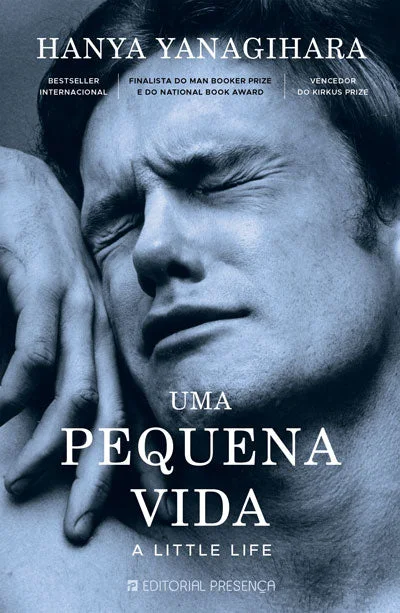
How Much Can One Person Possibly Survive?
There comes a point while reading A Little Life when tragedy stops surprising you. You begin bracing yourself whenever the book looks backwards.
The monastery. Brother Luke. Exploitation. Violence. Dr. Traylor.
Again and again, Jude is taught essentially the same horrifying lesson: that his body exists for other people to use, damage and discard. It would already be enough trauma for several novels, but A Little Life keeps going.
And going. And going.
Eventually I stopped asking, What happened to Jude? and started asking, What else can the author possibly do to him?
There is a point where suffering becomes so relentless that you begin to see the machinery behind it. You become aware of Yanagihara sitting there constructing another catastrophe. Jude doesn’t simply have a traumatic childhood; he seems to encounter almost every possible variation of human cruelty.
And that became one of my biggest problems with the novel. Devastation can be powerful, but when devastation becomes the default setting, does it eventually stop feeling real?
Is This Profound — Or Is It Misery Porn?
This is where my feelings about A Little Life become very conflicted, because being devastated by a book does not automatically make it profound.
Sometimes suffering reveals something extraordinary about a character. Sometimes suffering is just suffering.
There were moments when A Little Life pushed so relentlessly toward pain that I began to feel manipulated rather than moved. There is simply so much trauma. At a certain point, Jude’s history becomes almost unbelievably catastrophic, and each revelation seems designed to exceed the horror of the previous one.
Eventually I started wondering: is this novel exploring suffering, or is it exploiting suffering?
There were moments when Jude seemed less like a human being and more like an experiment. How much pain can one fictional person endure? How much can the reader endure alongside him? How many times can hope appear before the author threatens it again?
I wanted to reach into the book and tell Yanagihara: Leave this man alone.
Just for fifty pages. Let him go to brunch. Let him complain about something stupid. Let somebody have a birthday without emotional catastrophe lurking around the corner. Anything.
The Gay Novel I Wasn’t Expecting
What surprised me is that beneath all the horror, A Little Life is also one of the most intensely male love stories I’ve read — and I don’t just mean romantic love. It is full of men loving men in different ways: as friends, as fathers and sons, as lovers, as chosen family. Sometimes beautifully, sometimes destructively and sometimes in ways that are difficult to categorise at all.
That makes it especially interesting through a gay lens. The book isn’t primarily about homophobia or coming out, nor is it interested in explaining gay people to straight readers. Queerness simply exists inside a much larger story about intimacy, shame, masculinity, trauma and the desperate human need to be loved. Jude’s great struggle isn’t finding people capable of loving him — he finds them. His struggle is believing he deserves the love they offer, and that distinction is everything.
So when someone asks whether I recommend A Little Life, I genuinely don’t know what to say. It’s beautifully written in places, its characters can feel extraordinarily alive, its portrayal of friendship and chosen family can be deeply moving, and its depiction of queer male intimacy is far more complicated than I expected when I started reading it. Jude St. Francis is certainly not a character I am likely to forget.
But did I enjoy reading it? Absolutely not.
There were times I practically resented the book for making me continue, and yet I continued — page after page, hundreds of them — because Yanagihara had somehow convinced me that I needed to know what became of this man. I needed to know whether love could reach him, whether friendship could sustain him and whether someone who has spent his entire life believing himself fundamentally damaged can ever truly learn to see himself differently.
Above all, I needed the answer to the question that had been following me almost from the beginning: is there a light at the end of the tunnel?
I’m not telling you. You’ll have to suffer through the damn book like I did.
And that is the maddening contradiction of A Little Life. Bad books don’t usually haunt you. They don’t make you angry several days after finishing them or make you desperately wish you could sit one of their characters down and talk to him. They certainly don’t make you willingly read more than 700 pages while repeatedly thinking, I hate this. I hate this. I hate this. Okay, one more chapter.
Calling it the worst book I’ve ever read sounds like an insult, but I’m not entirely sure it is. I don’t remember the last time a novel made me feel so frustrated, protective, angry, hopeful, uncomfortable and emotionally exhausted all at once. Would I read it again? God, no. Am I glad I read it? Ask me again in a few years.
But will I forget Jude, Willem, Harold and the strange little family they created around one another? I doubt it.
And maybe that’s the most annoying thing about A Little Life: after everything it puts you through, it refuses to leave you alone.
Contribute
We value different opinions and stories! Want to contribute yours? Get in touch!
One response
-
[…] actually gave this book its own article on Chronicle 19—because I hated it. It’s exceptionally well written, but I found myself enduring hours of […]



Leave a Reply