

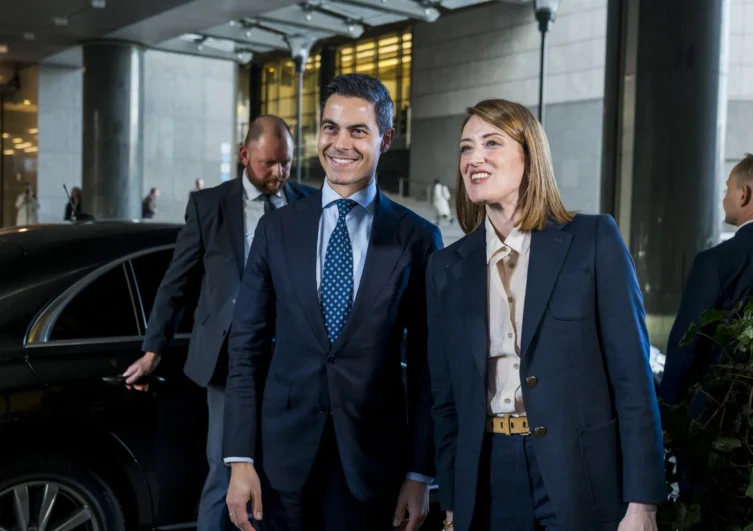
His rise follows years of gains for populist and far-right parties, but does it signal that voters are beginning to move in another direction?
There is something striking about the September cover of Attitude magazine.
Sitting comfortably on a white staircase is Rob Jetten, the 39-year-old prime minister of the Netherlands. Above him is a warning rather than a victory lap.
“Worldwide, there is a well-funded and well-organised attack on the queer community. We need to fight back.”
It is an unusual image for European politics in 2026.
Jetten is not simply an openly gay politician who reached high office. Since February, he has been the first openly gay prime minister of the Netherlands and the youngest person ever to hold the job.
His arrival also came after a period in which the Netherlands appeared to be moving sharply in the opposite political direction.
In 2023, Geert Wilders and his anti-immigration Freedom Party, the PVV, shocked Europe by becoming the largest party in the Dutch parliament. Two years later, Wilders brought down the government his party had helped create.
Then came Rob Jetten.
Who is Rob Jetten?
Jetten was born in 1987 and entered parliament in 2017 for Democrats 66, better known as D66, a socially liberal, strongly pro-European party that has occupied the Dutch political centre for decades.
Before politics, he studied public administration and worked for the Dutch railway infrastructure company ProRail. He later served as Minister for Climate and Energy Policy under Mark Rutte and became leader of D66 in 2023.
His early political career was not characterised by charisma.
Dutch media once nicknamed him “Robot Jetten” because of a speaking style critics considered overly rehearsed and mechanical. Over time, his public image changed. Television appearances and a more relaxed campaigning style helped introduce him to voters beyond the traditional D66 electorate.
That transformation became particularly important during the 2025 election campaign.
D66 entered the election with just nine seats. It emerged with 26.
The final result was extraordinarily close. D66 received 1,790,634 votes, while Wilders’ PVV received 1,760,966. Both parties won 26 seats, but D66 finished ahead in the popular vote.
Jetten had nearly tripled his party’s parliamentary representation.
In February 2026, he became prime minister.
The man who beat Wilders, but did not eliminate the politics behind him
It would be tempting to describe Jetten’s victory as the moment Dutch voters rejected the far right.
The reality is considerably more complicated.
Wilders lost ground compared with his 2023 result, but 1.76 million Dutch voters still backed his party. Other nationalist and anti-immigration parties also gained representation.
Reuters noted immediately after the election that Wilders’ setback should not be interpreted as the disappearance of the European far right. Researchers estimated that the proportion of Dutch voters willing to support strongly anti-immigration parties had actually increased over the longer term.
Jetten also did not form a left-wing government.
His minority coalition combines D66 with the centre-right VVD and the Christian Democratic CDA. Together they control only 66 of the 150 seats in the lower house, forcing the government to negotiate with opposition parties to pass legislation.
Its programme demonstrates why Jetten is difficult to reduce to a simple progressive versus conservative narrative.
His government supports European integration and stronger LGBTQ+ protections, but it has also promised stricter asylum rules, higher defence expenditure, changes to unemployment benefits, increased personal healthcare contributions and an accelerated rise in the retirement age.
Jetten therefore represents something different from a conventional return of the left.
He is closer to a socially liberal, pro-European political centre attempting to compete with populist parties while acknowledging some of the concerns that helped those parties grow.
An openly gay prime minister at a very different moment
Jetten’s sexuality was not the central issue of his election campaign.
That in itself is significant.
The Netherlands became the first country in the world to legalise same-sex marriage in 2001, and Jetten reached the premiership without having to make his identity the defining feature of his candidacy.
Since entering office, however, he has become much more outspoken internationally about LGBTQ+ rights.
During WorldPride Amsterdam, Jetten told Attitude that LGBTQ+ rights were under increasing pressure and argued that activists, governments and civil society organisations needed stronger international cooperation.
His government has discussed stronger protections against discrimination, improved police protection for LGBTQ+ people, greater access to surrogacy for same-sex couples and investment in education.
For Jetten, the issue is also personal.
He has spoken publicly about coming out as a teenager and about his relationship with Argentine Olympic hockey player Nicolás Keenan, to whom he is engaged.
His visibility places an openly gay couple at the centre of government at precisely the moment when debates over LGBTQ+ rights have intensified across parts of Europe and the United States.
That contrast has made him internationally prominent far beyond what might normally be expected of a Dutch prime minister.
After Trump, politics appeared to move sharply right
Donald Trump’s victory in the 2024 US presidential election was one of the most important political events of the decade. He returned to the White House in January 2025 after defeating Kamala Harris and began his second term with a Republican movement considerably more consolidated around him than during his first presidency.
But the broader shift toward nationalist and populist politics had begun before Trump returned.
Wilders had already won the Dutch election in 2023. Giorgia Meloni had become Italian prime minister in 2022. The Sweden Democrats had become increasingly influential in Swedish government policy. Germany’s AfD was expanding its vote share.
Trump’s return nevertheless provided these movements with a highly visible political reference point and demonstrated again that a populist leader who had once lost power could return.
Germany’s 2025 federal election illustrated the continuing strength of this political current. The AfD won 152 seats and became the country’s second-largest parliamentary force.
And the trend has hardly disappeared in 2026. German polling reported by Reuters on 16 September placed the AfD nationally at roughly 27 to 29 percent, while the party had recently achieved major gains in state elections.
So any suggestion that the far-right wave has simply ended would be premature.
But something else has also begun happening.
The counter-movement
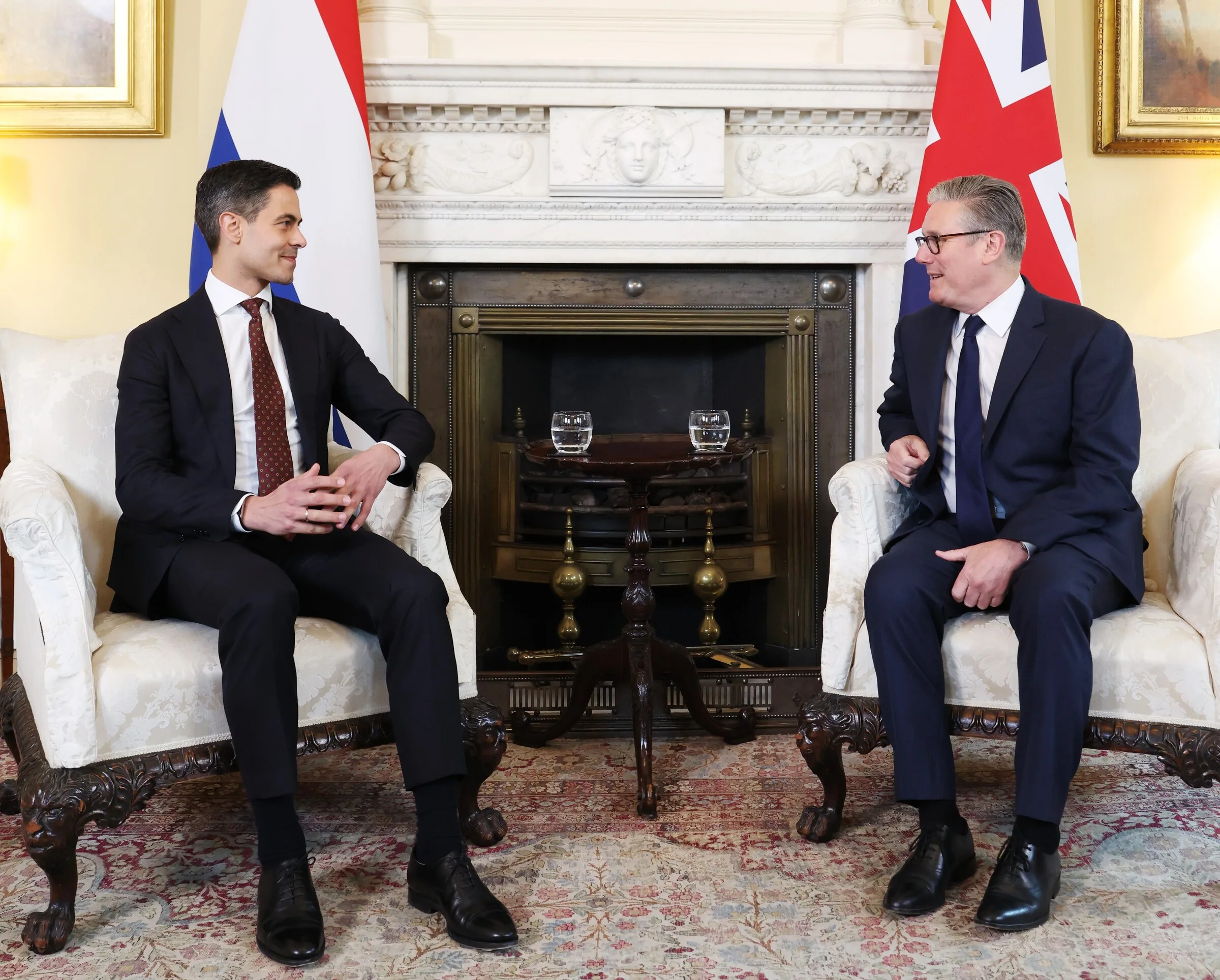
The Netherlands is not the only country where voters have recently stopped a populist or hard-right challenger from taking power.
In Romania in May 2025, centrist and pro-European candidate Nicușor Dan defeated hard-right nationalist George Simion by approximately 54 percent to 46 percent in the presidential runoff. Simion had openly drawn inspiration from Trump-style politics.
In Canada, Mark Carney’s Liberals staged an unexpected recovery and retained government in April 2025. Reuters reported that Trump’s tariffs and repeated comments about Canada becoming a US state contributed to a backlash that benefited the Liberals.
Then came the Netherlands, where Jetten overtook Wilders.
Sweden’s election on 13 September provided another example.
The completed count, announced on 17 September, gave the centre-left opposition 176 seats against 173 for the outgoing right-wing bloc. Prime minister Ulf Kristersson said he would resign. The Sweden Democrats suffered their first parliamentary-election decline after decades of growth, although the shape of the next government was not immediately settled.
Taken together, these results suggest that the political trajectory is no longer moving uniformly in one direction.
They do not establish a global progressive wave.
But they do show that the assumption of an unstoppable far-right advance is becoming harder to sustain.
Is Jetten the beginning of a new direction?
Possibly, but there is an important distinction.
What appears to be emerging is not necessarily a return to the politics of the 2010s.
Many centrist and centre-left parties have themselves moved.
Migration policies have tightened. Defence spending has increased. Concerns about borders, housing, integration and security that were once associated primarily with parties on the right have entered mainstream politics.
Sweden is a particularly clear example. Even if the centre-left ultimately returns to government, Reuters notes that it is unlikely to reverse many of the tougher immigration rules introduced in recent years.
Jetten’s Netherlands is similar.
He is socially liberal and strongly pro-European, yet his coalition is also pursuing tougher asylum policies and significant defence spending.
Perhaps the developing divide is therefore becoming less about traditional left versus right politics and more about two different responses to the same public anxieties.
One response emphasises nationalism, restrictions on migration and scepticism toward international institutions.
The other accepts that voters want greater control over borders, housing and security but attempts to combine those policies with European cooperation, institutional stability and protections for minority rights.
Jetten belongs firmly to the second camp.
And there is another problem for the Jetten narrative
His election victory should not be confused with overwhelming public support for his government.
Seven months into office, Jetten is already experiencing the difficulties of governing.
An Ipsos I&O poll conducted on 1 and 2 September put D66 at a projected 20 seats, six fewer than it won in the election. Only 18 percent of respondents said they were satisfied with the government, while 70 percent were dissatisfied.
A separate RTL Nieuws panel conducted between 8 and 14 September found that confidence in Jetten personally had declined from 47 percent when he entered office to 29 percent. A majority still described him positively on a personal level, but respondents were considerably less positive about the government’s ability to deliver results.
That matters.
Winning an election against a populist movement and successfully governing afterwards are two very different things.
Wilders himself discovered that.
Jetten may now face the same test from the opposite side.
A pendulum, not a revolution
Politics rarely moves permanently in one direction.
Trump’s return, the rise of the AfD, the success of Wilders and the growing influence of nationalist parties across Europe demonstrated that liberal democracies could move significantly to the right.
The victories of Jetten, Carney and Dan, together with the setback suffered by the Sweden Democrats, demonstrate something else.
Those movements can also face electoral resistance.
For LGBTQ+ people in particular, Jetten’s presence has an obvious symbolic dimension. At a time when sexuality and gender have again become political dividing lines in several countries, one of Europe’s national governments is led by an openly gay man who speaks publicly about marrying his male partner and having children.
But the larger political significance of Rob Jetten may ultimately depend on something less symbolic.
He has to show that the political centre can govern.
If governments like his can address housing, migration, economic insecurity and public services while maintaining liberal democratic institutions and minority protections, their electoral model may prove durable.
If they cannot, populist challengers remain very much present.
So the political pendulum may indeed be moving again.
It is simply far too early to know where it will stop.
Contribute
We value different opinions and stories! Want to contribute yours? Get in touch!
One response
-
[…] Rob Jetten and Zohran Mamdani met at The Lesbian, Gay, Bisexual & Transgender Community Center in Manhattan on 24 September, during the Dutch prime minister’s visit to New York for the United Nations General Assembly. Jetten is the Netherlands’ first openly gay prime minister. […]

Leave a Reply