There is no worldwide census of LGBTQ+ people. Sexual orientation and gender identity are not routinely measured in population censuses, and the way people identify can also vary depending on the country, culture and survey methodology.
However, several large-scale studies and population estimates provide an indication of the size of the LGBTQ+ population around the world.
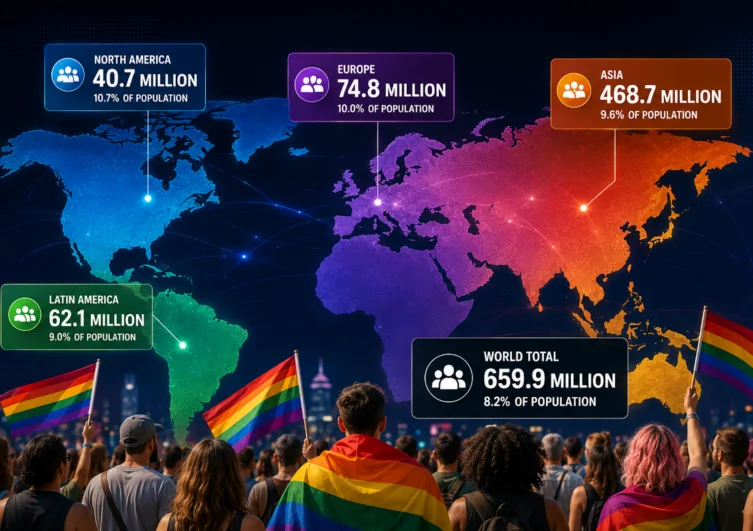
One of the broadest estimates comes from Frost & Sullivan, in research commissioned by Grindr. The study estimates that 659.9 million people worldwide will identify as LGBTQ+ in 2026, representing approximately 8.2% of the global population.
Where does the LGBTQ+ population live?
The Frost & Sullivan estimate provides figures for several major regions. According to the study, Asia has by far the largest LGBTQ+ population in absolute numbers, largely because of its much larger overall population.
| Region | Estimated LGBTQ+ population | Estimated share |
|---|---|---|
| North America | 40.7 million | 10.7% |
| Europe | 74.8 million | 10% |
| Asia | 468.7 million | 9.6% |
| Latin America | 62.1 million | 9,0% |
| World | 659.9 million | 8,2% |
The study estimates that the LGBTQ+ population has grown considerably over the past decade, from around 390 million in 2016 to 538.4 million in 2021, with the global figure projected to reach almost 660 million in 2026.
The figures refer to people who self-identify as LGBTQ+. Frost & Sullivan also notes that estimates can vary between countries because of cultural, political and economic differences, as well as differences in people’s willingness to disclose their sexual orientation or gender identity.
Europe: around 75 million
Europe is estimated to have 74.8 million LGBTQ+ people in 2026, representing approximately 10% of the region’s population. The same estimate put the figure at 61.6 million, or 8.2%, in 2021.
The figure should not be confused with an official European Union statistic. The Frost & Sullivan research uses a broader regional definition of Europe, rather than simply counting the 27 EU member states.
Independent European research produces different results when using narrower definitions. A 2025 academic study based on EU-wide survey data estimated that 6.1% of people in the 27 EU member states identified as LGB+. That figure is not directly comparable with the Frost & Sullivan estimate because it focuses on sexual orientation and uses a different methodology.
The United States: 25.6 million adults
In the United States, a new analysis by the Human Rights Campaign Foundation estimates that 25.6 million adults identify as LGBTQ+, equivalent to approximately 12% of the adult population.
The HRC Foundation’s estimate is based on more than 2.4 million responses to the U.S. Census Bureau’s Household Pulse Survey, collected between 2021 and 2024. This makes it a particularly large dataset for measuring LGBTQ+ identification in the United States.
The estimate is higher than some other major surveys. Gallup, for example, has produced a lower estimate in recent years. Differences like these demonstrate why LGBTQ+ population figures should be treated as estimates rather than definitive counts.
Nearly 30% of Gen Z identify as LGBTQ+
The numbers are considerably higher among younger generations.
The Human Rights Campaign currently cites research showing that nearly 30% of Gen Z adults identify as LGBTQ+. The figure comes from polling conducted by the Public Religion Research Institute (PRRI), which found that 28% of adults aged 18 to 25 identified as LGBTQ+.
The same PRRI research found lower levels among older generations: 16% of Millennials, 7% of Generation X, 4% of Baby Boomers and 4% of the Silent Generation identified as LGBTQ+.
The difference between generations is one of the most striking features of current LGBTQ+ population research. It may reflect changing social attitudes and greater willingness among younger people to disclose their sexual orientation or gender identity, rather than simply a sudden change in the underlying population.
Frost & Sullivan’s own global estimates also show a strong age effect. Its research estimated that 10.3% of 18–24-year-olds globally identified as LGBTQ+ in 2021, with the figure projected to reach 13.4% by 2026.
The two figures should not be directly compared: the PRRI figure concerns Gen Z adults in the United States, while the Frost & Sullivan figure is a global estimate for the 18–24 age group.
Why don’t we have an exact number?
The simple answer is that most countries do not ask every citizen whether they are LGBTQ+.
Even when surveys do ask, the results depend on how the question is phrased, which identities are included and whether respondents feel safe enough to answer honestly.
This is particularly important in countries where homosexuality is criminalised or where LGBTQ+ people face significant social stigma. A low percentage in a survey does not necessarily mean that fewer LGBTQ+ people exist there; it may partly reflect people’s willingness or ability to identify themselves openly.
For this reason, the figures above should be understood as estimates of people who identify as LGBTQ+, rather than a definitive count of everyone who may experience same-sex attraction or have a gender identity that differs from the sex assigned at birth.
A growing and increasingly visible population
Despite the limitations of the available data, the different studies point in the same broad direction: LGBTQ+ people represent a substantial proportion of the world’s population, and younger generations are considerably more likely to identify as LGBTQ+ than older generations.
The challenge for researchers is no longer simply finding evidence that LGBTQ+ populations exist on a large scale. It is developing consistent, comparable ways of measuring those populations across countries and continents.
Until that happens, estimates such as the 659.9 million global figure, the 74.8 million estimate for Europe and the 25.6 million US estimate provide useful but not perfectly comparable snapshots of the world’s LGBTQ+ population.