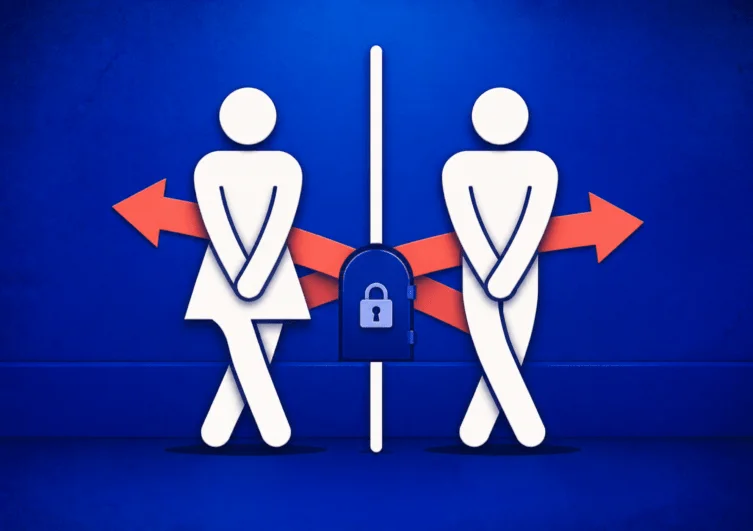
We are all apparently obsessed with the bathroom dilemma. And don’t get me wrong: it is wonderful to know that first-world countries have finally solved every other problem on Earth and can now focus entirely on deciding who is allowed to use which toilet. No more crime. No more poverty. Everyone is prosperous, fulfilled and perfectly happy. The only urgent matter left on the political agenda in 2026 is determining who may pee behind which locked door.
What a time to be alive.
The fear of trans women using women’s bathrooms has always confused me, partly because I am not sure what some people imagine happens inside them. Don’t women use private stalls behind closed doors? Are toilets in women’s bathrooms arranged in an open circle for some sort of communal gathering? Does everyone enter, introduce themselves and begin inspecting one another’s genitals before getting down to business? And where did all these protesters go when it’s time to lock down millions of public establishments that currently hold one bathroom for all genders where we have to enter, lock the door, do our business and leave, like normal adults? Lazy protesting I’m telling you.
Of course, pointing out that bathrooms have stalls is not dramatic enough to sustain a moral panic. So opponents of trans inclusion moved on to a more alarming argument: trans women supposedly pose a special danger to other women. They might enter bathrooms to prey on, harass or assault them, we are told.
It sounds terrifying, right up until someone asks for evidence that trans-inclusive bathroom policies have produced this wave of violence. Then the scandalous statistic becomes remarkably shy. It was definitely around a moment ago. Someone saw it on social media. A friend of a cousin may have shared it. But now that we are asking for actual numbers, it appears to have locked itself inside a stall and refuses to come out.
That does not mean women’s safety is unimportant. Quite the opposite. Sexual harassment and assault are serious issues, and predators should be dealt with as predators. But that is exactly the point: assault is already illegal, regardless of which bathroom it happens in or what identity the attacker claims. A sign on a door is not a magical security barrier. Someone willing to commit an assault is unlikely to be stopped by a small plastic silhouette wearing a skirt.
Meanwhile, men’s bathrooms receive far less public scrutiny. Most men do not seem terribly concerned about who is standing at the next urinal, much less who is sitting inside a closed stall. There is no identity checkpoint. Nobody is producing a birth certificate beside the hand dryer. People generally follow the traditional bathroom social contract: enter, do what you came to do, make as little eye contact as possible and leave. Women are less of a threat to men they say – physical strength, testosterone driven anger, etc. they say. I guess. Maybe.
But this is where the bathroom argument becomes genuinely strange, because there is an obvious question almost nobody seems interested in asking: What happens to trans men?
If bathroom access must be determined by sex assigned at birth, trans men must use women’s bathrooms. I question myself – why is nobody talking about this? That includes trans men with beards, deep voices and completely masculine appearances. Under the policy demanded by opponents of trans inclusion, these men would be required to walk into women’s bathrooms, not because they wanted to, but because they had been ordered to do so.
So now a man with a beard enters the women’s bathroom. Someone becomes alarmed and tells him he is in the wrong place. He then has to explain that, according to the very rules supposedly designed to protect everyone, he is exactly where he has been told to go.
Problem solved, apparently.
Except this creates the precise situation the policy’s supporters claim to fear: people who look like men entering women’s bathrooms. It does not prevent that outcome. It mandates it.
And if the fear is that male predators will pretend to be trans women to gain access to women’s bathrooms, would these rules not hand them an even easier excuse? A man could enter and claim that he was born female and is therefore obeying the law. Now, he doesn’t even have to put on a wig, fake boobs and stillettos. Even a construction hat, overalls and cement-filled boots will do. “I’m a trans man, this is where you want me.” How would anyone challenge him? Would someone demand his medical records? Inspect his body? Station a genital security officer at every public toilet?
I would love to think “bathroom genital inspector” is too absurd a job title for reality, but the political imagination has been working overtime lately.
This is the contradiction at the centre of the entire debate. People say trans women must be excluded because their presence would allow male predators into women’s spaces. Their proposed solution is then to require trans men, people whom strangers will often perceive as male, to enter those same spaces. In trying to prevent an imagined loophole, they create a real one, while forcing trans people into situations that may be humiliating, confrontational or dangerous, in a world where they’re trying to exist – not to assault an assortment of female genitals which they would have had easier access to in a bar, had they remained a cis man. For THIS, we have statistics. But let’s ignore that, since we’ve been doing that with the opposite claims.
None of this is to suggest that every concern about privacy should be mocked or dismissed. Privacy matters, which is why bathrooms have stalls and locks. Safety matters, which is why harassment and assault should be taken seriously no matter who commits them. But if a policy produces the opposite of its stated goal, perhaps the problem is not that we have failed to enforce it harshly enough. Perhaps it is simply a bad policy.
I do not pretend to have the definitive answer to every question surrounding public bathrooms. I am only asking why this glaring contradiction receives so little attention, when it seems to me, the most dangerous route to allowing real male predators to the female bathroom is by creating policy that assigns a bathroom by gender at birth, regardless of appearance.
Call me confused – I am – but we are not solving a safety problem. We are manufacturing a bathroom crisis, forcing everyone into more absurd situations and congratulating ourselves for being the adults in the room.