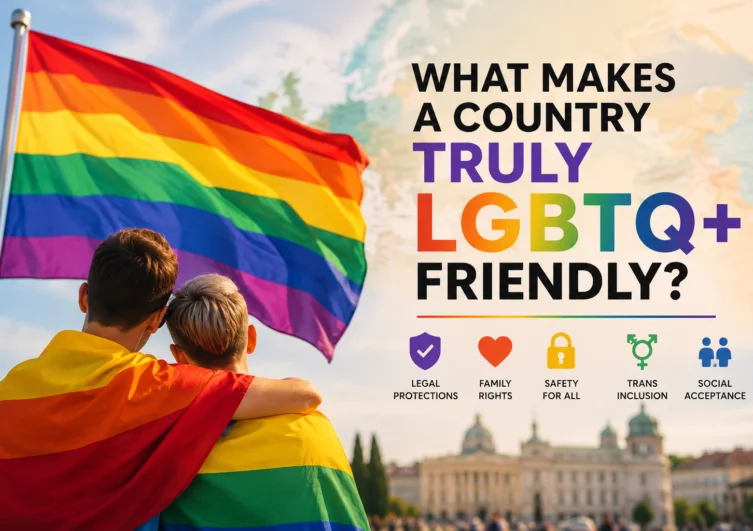
When people talk about LGBTQ+ friendly countries, the conversation often begins and ends with marriage equality. While the right to marry is undeniably important, it is only one piece of a much larger picture.
A country can have progressive laws on paper and still be a difficult place for LGBTQ+ people to live. Likewise, some destinations may feel welcoming to visitors while offering limited legal protections to residents. So what actually makes a country truly LGBTQ+ friendly?
It Starts With Legal Protection
One of the clearest indicators is whether LGBTQ+ people are protected by law.
This includes protection against discrimination in employment, housing, healthcare, education, and public services. Without these safeguards, LGBTQ+ people can face unequal treatment in everyday life with little legal recourse.
Many organisations use these protections as a benchmark when evaluating countries. The annual Rainbow Map produced by ILGA-Europe, for example, assesses countries across dozens of legal and policy criteria, including equality and non-discrimination measures.
Family Rights Matter
Marriage equality has become a major symbol of LGBTQ+ rights, but family recognition extends beyond marriage.
Questions such as whether same-sex couples can adopt children, access assisted reproduction, or have their parental rights recognised are equally important.
For many LGBTQ+ people, true equality means being able to build and protect a family under the same legal framework as everyone else. The Rainbow Map evaluates these family rights as a distinct category when assessing countries.
Safety Cannot Be Ignored
A country may have progressive laws, but if LGBTQ+ people regularly face harassment, violence, or hate crimes, those protections can feel hollow.
Effective hate crime legislation, police training, and public policies aimed at preventing discrimination all contribute to creating safer environments.
Feeling safe while holding a partner’s hand in public is often a better measure of daily life than any single law.
Trans Rights Are Part Of The Picture
Discussions about LGBTQ+ friendliness increasingly include the experiences of transgender and non-binary people.
Legal gender recognition, access to healthcare, and protection from discrimination are important factors in determining how inclusive a country really is.
ILGA-Europe includes legal gender recognition among the categories used to assess LGBTQ+ rights across Europe.
Social Acceptance Matters Too
Laws are important, but culture matters.
A country may score highly on legal protections while parts of society remain resistant to LGBTQ+ visibility. Conversely, some communities can be remarkably welcoming despite gaps in legislation.
The reality experienced by LGBTQ+ people is shaped by both legal rights and social attitudes. One without the other rarely creates true equality.
LGBTQ+ Friendly Countries Beyond Rankings
Rankings such as ILGA-Europe’s Rainbow Map provide a valuable snapshot of the legal and policy landscape. In 2025, countries such as Malta, Belgium, Iceland, Denmark and Spain were among Europe’s highest-ranked nations for LGBTQ+ rights.
However, no ranking can fully capture everyday experiences.
The most LGBTQ+ friendly countries are not simply those with the highest scores. They are the places where legal protection, social acceptance, personal safety, and equal opportunities come together to allow people to live openly and authentically.
The Bottom Line
Being LGBTQ+ friendly is about far more than rainbow flags, Pride celebrations, or even marriage equality.
A truly inclusive country protects LGBTQ+ people under the law, recognises their families, safeguards their rights, promotes their safety, and fosters a culture where they can participate in society without fear.
The goal is not merely tolerance. It is equality, dignity, and the freedom to live openly as oneself.