When Zohran Mamdani became mayor of New York City on 1 January 2026, he represented a significant generational and political shift for America’s largest city. At 34, he was New York’s youngest mayor in more than a century, as well as its first Muslim, first South Asian and first African-born mayor.
Born in Kampala, Uganda, in 1991, Mamdani moved to New York with his family when he was seven. He is the son of filmmaker Mira Nair and academic Mahmood Mamdani. Before entering politics, he worked as a housing counsellor, helping low-income homeowners facing eviction. He was elected to the New York State Assembly in 2020, representing part of Queens.
A member of the Democratic Party and the Democratic Socialists of America, Mamdani built his political identity around the cost of living. His mayoral campaign promised affordable housing, rent freezes, free buses and childcare. It also proposed higher taxes on wealthy residents and large corporations. His rise was helped by energetic social-media campaigning and a message that presented city government as a tool for improving people’s everyday lives.
What does the mayor of New York do?
As mayor, Mamdani leads New York City’s executive government. His administration oversees services affecting more than eight million residents, including policing, public schools, housing, transport, sanitation and public health.
The position is powerful, but the mayor cannot govern alone. Major spending decisions require cooperation with the City Council. Meanwhile, some of Mamdani’s most ambitious proposals depend on support from New York State. His role therefore involves more than announcing policies. He must negotiate budgets, appoint senior officials, manage city agencies and respond to communities with widely differing priorities.
For Mamdani, the central challenge is turning an ambitious progressive programme into policies that can operate at the scale of New York. His supporters see his election as an opportunity to make the city more affordable and inclusive. Critics question whether his plans are financially and politically achievable.
His position on LGBTQ+ rights
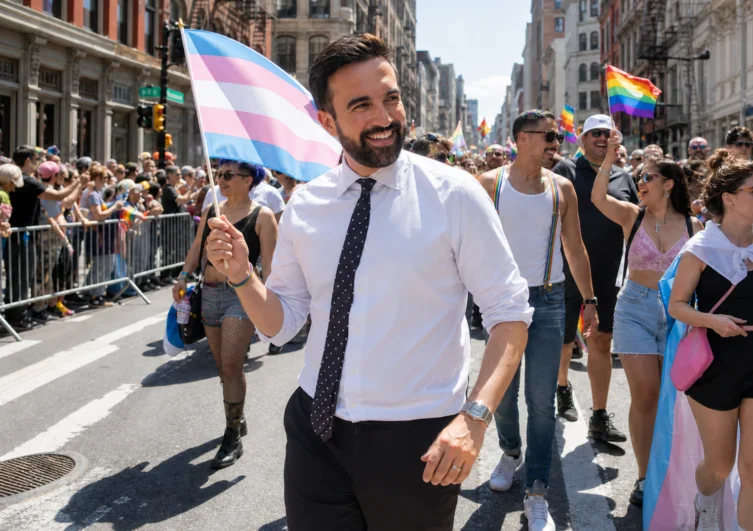
Mamdani has consistently presented himself as an ally of LGBTQ+ New Yorkers, with a particular focus on protecting transgender people. His public position is that LGBTQ+ rights are civil and human rights and that New York should provide refuge to people facing discrimination elsewhere.
In March 2026, he established the city’s first Mayor’s Office of LGBTQIA+ Affairs. The office is responsible for coordinating policy across city agencies, improving access to services and developing legal resources to uphold New York’s status as a sanctuary for LGBTQIA+ people and families escaping persecution.
Mamdani appointed civil-rights lawyer Taylor Brown as its first director. According to the administration, Brown became the first openly transgender person to lead a New York City office or agency. The initiative fulfilled one of Mamdani’s central campaign promises. (NYC Mayor’s Office)
His administration has also announced a $15 million programme intended to expand gender-affirming healthcare. Its measures include greater clinical capacity, improved navigation services for people seeking care and support for community organisations. The programme applies to both young people and adults. However, its funding is lower than the larger investment discussed during Mamdani’s campaign. (NYC Mayor’s Office)
Mamdani has supported expanding LGBTQ+ healthcare across all five boroughs. He also wants the city to act against institutions that unlawfully deny gender-affirming care. He has also defended the visibility of LGBTQ+ history. When the Pride flag was removed from the Stonewall National Monument by federal authorities, Mamdani condemned the decision and reaffirmed New York’s place in the history of the modern LGBTQ+ rights movement.
These positions are especially notable because Mamdani is a practising Muslim and has sometimes faced attempts to portray his faith as incompatible with LGBTQ+ equality. His record rejects that assumption: he has treated religious identity and support for queer and transgender rights as entirely compatible.
Promises, scrutiny and a breath of fresh air
Mamdani’s stance is clearly supportive, but his administration will ultimately be judged by implementation. Creating a dedicated LGBTQIA+ office gives queer and transgender New Yorkers a permanent point of representation within City Hall. Healthcare funding and legal protections may also make a measurable difference, particularly while LGBTQ+ rights face challenges at the federal level and in other parts of the United States.
At the same time, campaign promises must be compared with the funding delivered, the services opened and the experiences of LGBTQ+ residents themselves. Supporters can welcome his direction while still asking whether his policies go far enough.
Many also continue to debate Mamdani’s economic programme—and whether its long-term costs will outweigh its promised benefits. Yet his leadership offers something refreshing in today’s political climate. Some politicians devote considerable energy to attacking transgender rights and turning LGBTQ+ lives into a culture-war battleground. In contrast, Mamdani has chosen to use his office to protect people rather than persecute them.
As a naturalised citizen, he is constitutionally ineligible to run for US president. Nevertheless, his optimism, his defence of LGBTQ+ New Yorkers and his enthusiasm for planting more trees have brought a welcome breath of fresh air to public life. If he cannot reach the White House, he can at least help make New York greener, kinder—and considerably less full of hot air.