

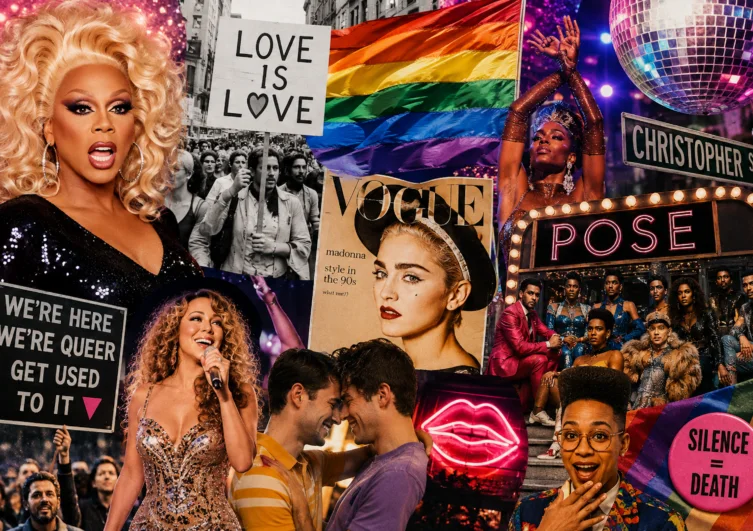
LGBTQ+ culture has influenced the mainstream in ways that are easy to overlook. From nightlife and fashion to language, television and music, ideas that once belonged largely to queer spaces have gradually become part of everyday popular culture.
Here are 10 things LGBTQ+ people helped bring into the mainstream.
1. Drag
Drag existed long before it became a television phenomenon. But queer communities transformed it into a distinctive form of performance, fashion, comedy and self-expression.
Today, drag queens can headline major venues, appear in advertising campaigns and become international celebrities. Shows such as RuPaul’s Drag Race helped take a culture that had largely developed in queer clubs and bars to audiences around the world.
2. The Rainbow Flag
Created by artist and activist Gilbert Baker in 1978, the rainbow flag was designed as a symbol of LGBTQ+ pride and diversity.
What began as a community symbol in San Francisco eventually became instantly recognisable around the world. It now appears everywhere from Pride marches to clothing, advertising, public buildings and social media.
Few symbols have travelled so successfully from a marginalised community into global popular culture.
3. Pride
What began as demonstrations demanding visibility and equal rights has become one of the world’s most recognisable annual cultural events.
Pride parades now take place in cities across the globe, attracting millions of participants and spectators. While their political roots remain important, Pride has also become a major part of contemporary culture, influencing fashion, music, advertising and entertainment.
4. Ballroom Culture
Long before Pose introduced ballroom to a mainstream television audience, Black and Latino LGBTQ+ communities in New York were creating their own underground world of balls, houses, categories and performance.
Voguing, in particular, eventually escaped the ballroom scene and entered mainstream pop culture. Madonna’s 1990 hit “Vogue” helped introduce the style to an enormous international audience.
What had developed as a form of expression and competition within queer communities became a global dance phenomenon.
5. Queer Slang
Language moves between communities, and LGBTQ+ communities have played a significant role in creating, adapting and popularising expressions that eventually entered wider culture.
Words and phrases associated with drag, ballroom and queer communities have increasingly appeared in television, music, social media and everyday conversation.
The process is not always straightforward and some expressions have been adopted without acknowledgement of where they came from but queer language has undeniably influenced the way people communicate.
6. Camp
Exaggerated, theatrical, ironic and deliberately over-the-top, camp has deep roots in queer culture.
For decades, LGBTQ+ people used humour, performance, fashion and exaggeration to create their own forms of expression. Today, camp is everywhere: in fashion shows, celebrity performances, advertising, television and internet culture.
What was once dismissed as simply “too much” has become a celebrated aesthetic.
7. Queer Fashion
LGBTQ+ people have repeatedly challenged conventional ideas about what men and women are supposed to wear.
From the flamboyant styles of queer nightlife to gender-fluid fashion on today’s runways, queer communities have helped make experimentation with clothing far more visible.
High heels on men, gender-neutral clothing, extravagant costumes and deliberately blurred gender codes are no longer confined to underground spaces.
8. The Pop Diva–Gay Fandom Connection
The relationship between LGBTQ+ audiences and female pop stars is one of the most recognisable phenomena in popular music.
From Judy Garland and Cher to Madonna, Kylie Minogue and Lady Gaga, generations of gay men in particular have embraced performers whose music, performances and public personas became part of queer cultural life.
The relationship works both ways: queer audiences have helped turn certain performers into icons, while artists have often embraced and supported the communities that made them icons.
9. Queer Stories in Mainstream Television
There was a time when LGBTQ+ characters were often reduced to stereotypes, side characters or tragic storylines.
That has changed dramatically.
From Will & Grace and Queer as Folk to Pose, Heartstopper and countless other shows, queer characters and relationships have increasingly become part of mainstream storytelling.
The significance isn’t simply that LGBTQ+ people appear on television. It is that audiences have become accustomed to seeing them as the protagonists of ordinary stories about love, friendship, family and ambition.
10. Being Proud in Public
Perhaps the biggest thing LGBTQ+ culture helped make mainstream is something that sounds surprisingly simple: being openly yourself.
Holding hands with a same-sex partner, wearing a rainbow, talking openly about sexuality or gender, and refusing to hide who you are were once acts that could carry enormous personal and social consequences.
Today, visibility is still political in many parts of the world. But the idea that LGBTQ+ people should be able to live openly has become increasingly familiar across mainstream culture.
That change did not happen by accident. It was built by generations of people who created communities, made art, challenged conventions and refused to disappear.
And perhaps that is the most important influence LGBTQ+ culture has had on the mainstream: it made being different visible and made visibility impossible to ignore.
One response
[…] The series has developed a dedicated audience through its exploration of class, ambition, workplace power and personal relationships, while featuring LGBTQ+ characters and storylines. […]