

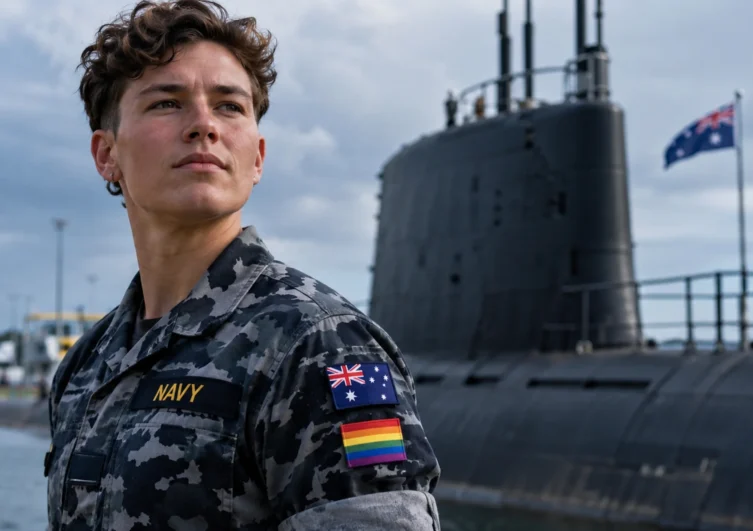
Transgender and non-binary members of Australia’s navy are being prevented from entering the country’s nuclear submarine training programme because of restrictions imposed by the United States under President Donald Trump, despite being eligible to serve in the Australian military.
Internal Australian Defence Force (ADF) documents, obtained through freedom of information laws and revealed by The Guardian on 16 November 2026, show that American military policies are directly affecting the career opportunities of Australian service personnel.
The restrictions are linked to AUKUS, the defence partnership between Australia, the United Kingdom and the United States, which aims to equip Australia with a fleet of nuclear-powered submarines.
Although Australia maintains policies allowing transgender personnel to serve, its dependence on American submarine training means those policies cannot currently guarantee equal access to the programme.
Australian Soldiers, American Rules
The documents reveal that transgender and non-binary Australian sailors, officers and prospective recruits are currently unable to begin training for nuclear-powered attack submarines.
The reason is straightforward: Australia does not yet operate nuclear-powered submarines, meaning its personnel must receive essential training in the United States.
Under the AUKUS agreement, hundreds of Australian sailors and officers are already training aboard American nuclear submarines and at US naval facilities.
However, military personnel undertaking duties in the United States must comply with American government policies, including restrictions affecting transgender service members.
An internal ADF briefing acknowledges that Australia’s equality and inclusion policies remain unchanged, but that American government policy differs.
As a result, transgender and non-binary Australians are currently unable to enter the nuclear submarine training pathway, even though they remain eligible to serve in their own country’s armed forces.
The documents do not establish how many Australian personnel have already been excluded from the programme.
Trump’s Military Ban Reaches Beyond US Borders
The restrictions stem from policies introduced during Donald Trump’s second presidential term.
In January 2025, Trump signed an executive order targeting transgender military service, reversing the previous administration’s approach to transgender personnel.
The measures have faced legal challenges in the United States, but their impact is now being felt beyond American military ranks.
Australia’s situation demonstrates how the policies of one country can affect the military careers of personnel serving another government.
Australian transgender sailors are not attempting to enlist in the US military. They are seeking to serve in Australia’s navy, under Australia’s own employment and military standards.
Nevertheless, because their specialised training depends on access to American submarines and facilities, US restrictions have effectively become an obstacle to their progression.
Australian Navy Acknowledges the Problem
Rear Admiral Tish van Stralen, one of the Australian navy’s most senior female officers, publicly addressed the situation during a Women in Defence event in October.
She reaffirmed the ADF’s commitment to equal opportunities but acknowledged the difficulties created by American requirements.
Van Stralen explained that Australia must consider the policies of countries where its military personnel undertake training, while also protecting the welfare of its sailors.
She acknowledged that placing gender-diverse personnel into the American training programme would currently be extremely difficult.
Rather than exposing affected personnel to potentially harmful circumstances, the navy is examining alternative career pathways.
One possibility involves training opportunities in the United Kingdom, Australia’s other AUKUS partner, where policies concerning transgender military personnel are more inclusive.
However, no confirmed alternative training arrangement has been announced, and it remains unclear whether British facilities could provide a complete replacement for the American training pathway.
AUKUS Faces a Workforce Challenge
The restrictions emerge as Australia prepares for one of the largest military transformations in its history.
Under AUKUS, Australia plans to acquire three American Virginia-class nuclear-powered submarines, with deliveries expected to begin in 2032, before eventually developing a new generation of submarines in cooperation with the United Kingdom.
The transition will require a substantial increase in the number of qualified submariners.
A Virginia-class submarine typically operates with approximately 135 crew members, more than twice the number aboard Australia’s existing Collins-class submarines.
Recruiting, training and retaining sufficient personnel is therefore a central challenge for the programme.
Australian Defence Minister Richard Marles has acknowledged the need to accelerate training, while the government’s submarine workforce strategy explicitly encourages the recruitment of people from underrepresented communities.
The exclusion of transgender and non-binary personnel from the nuclear submarine training pathway creates a conflict between those recruitment objectives and the practical requirements of cooperation with the United States.
It also raises questions about how Australia intends to maintain its own military inclusion policies while relying on a defence partner whose policies differ.
Uncertain Prospects for Transgender Sailors
Australia has allowed transgender people to serve openly in its armed forces since 2010, and the ADF has maintained its existing equality and inclusion framework despite the changes introduced in Washington.
Transgender and non-binary Australians are not generally prohibited from military service or from pursuing other naval careers.
The restriction specifically concerns the nuclear-powered submarine training pathway and the American facilities on which it currently depends.
The Australian Department of Defence has not disclosed how many people have been affected or whether alternative arrangements could eventually allow them to qualify for nuclear submarine service.
For prospective recruits, the uncertainty could influence career decisions long before they reach the training stage.
The situation also illustrates a broader consequence of the Trump administration’s transgender military restrictions: their effects are no longer confined to American service members.
Through AUKUS, they are shaping which Australians can train for some of the most specialised positions in their own navy.

Leave a Reply