

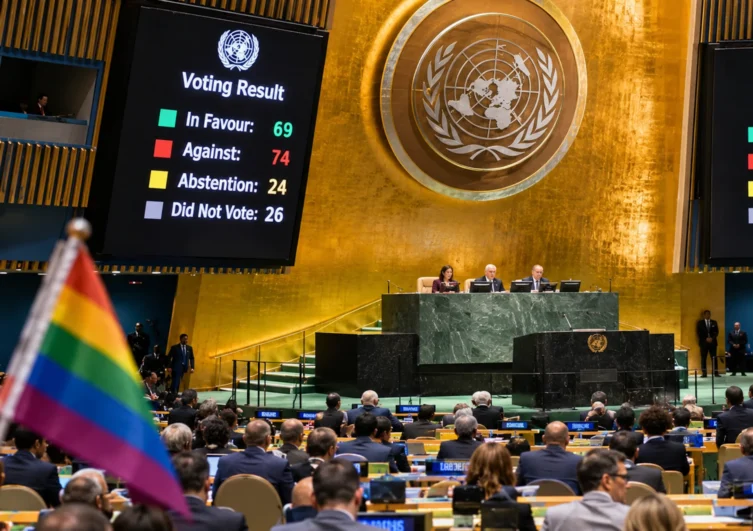
The United Nations has narrowly rejected an attempt to remove explicit references to sexual orientation and gender identity from a resolution condemning unlawful killings, in a vote that revealed growing divisions over LGBTQ+ rights and a significant change in the United States’ position.
On 13 November 2026, the UN General Assembly’s Third Committee voted 74 to 69 against an amendmentintroduced by Egypt on behalf of most members of the Organisation of Islamic Cooperation. Another 24 countries abstained, while 26 did not vote.
The amendment sought to delete language recognising people targeted for unlawful killings because of their sexual orientation or gender identity.
Although the proposal was defeated, the five-vote margin was considerably narrower than in 2024, when a similar amendment was rejected by 78 votes to 47.
The United States was among the countries supporting the removal, marking the first time in the voting record dating back to 2002 that Washington had backed deleting these references from the resolution.
A Victory by Just Five Votes
The resolution on extrajudicial, summary and arbitrary executions is introduced every two years by the Nordic countries. It calls on governments to prevent unlawful killings, investigate suspected violations and ensure accountability for those responsible.
It also identifies groups facing particular risks of targeted violence, including journalists, human rights defenders, Indigenous peoples, religious minorities and people targeted because of their sexual orientation or gender identity.
Sexual orientation has been explicitly recognised in the resolution since 2002, with gender identity added in 2012.
Egypt’s proposed amendment would have replaced the specific reference with broader language, removing the explicit recognition of LGBTQ+ victims.
Following the amendment’s defeat, the Third Committee adopted the full draft resolution by 131 votes in favour, none against and 47 abstentions, with 15 countries not voting.
The LGBTQ+ references therefore remain in the text approved by the committee.
However, the outcome is not yet final.
The United States Changes Sides
One of the most significant developments was the decision by the United States to support the Egyptian amendment.
In previous votes, Washington had opposed attempts to remove references to sexual orientation and gender identity.
In 2010, the United States even helped restore the reference to sexual orientation after it had been removed during the committee stage of the UN process.
Its position in November 2026 represents a departure from that earlier approach.
The change also follows developments in December 2025, when an amendment removing references to sexual orientation and gender identity from a separate UN resolution on the rights of persons with disabilities succeeded in the General Assembly.
That amendment passed by 81 votes to 77 following lobbying involving Egypt and the United States.
The two resolutions concern different human rights issues, but the earlier result demonstrates that language preserved during committee negotiations can still be removed when the full General Assembly votes.
Growing Opposition to Explicit LGBTQ+ Recognition
The narrowing margin between the 2024 and 2026 votes is particularly significant.
Two years ago, 47 countries supported removing the LGBTQ+ references. This year, that number increased to 69.
Meanwhile, the number of countries opposing the amendment fell from 78 to 74.
Finland, which led the resolution alongside Denmark, Iceland, Norway and Sweden, defended the inclusion of groups facing documented risks of targeted violence.
Australia, Brazil, Canada, Mexico, Uruguay and the European Union were among those expressing support for retaining the language.
The dispute does not concern whether LGBTQ+ people possess the fundamental right to life, which is protected under international human rights law regardless of sexual orientation or gender identity.
Instead, it concerns whether international resolutions should explicitly acknowledge that LGBTQ+ people face particular risks of violence and whether governments should be encouraged to recognise those circumstances when investigating unlawful deaths.
Removing the references would not legalise the killing of LGBTQ+ people. Human rights organisations nevertheless argue that eliminating explicit recognition could weaken attention to discriminatory motives and patterns of violence.
Human Rights Organisations Warn of the Consequences
Outright International welcomed the rejection of the amendment while warning that the increasingly narrow voting margin should not be overlooked.
The organisation recently published Killed for Who They Are, a report documenting more than 230 targeted killings of LGBTQ+ and intersex people worldwide between January 2020 and July 2026.
The victims ranged in age from 12 to 77.
Researchers emphasised that the documented cases represent only a fraction of the likely total, particularly in countries where discrimination, criminalisation and inadequate investigations make violence difficult to record.
According to the report, 65 UN member states continue to criminalise consensual same-sex conduct, while only 63 formally recognise hate crimes based on sexual orientation and 40 recognise those based on gender identity.
Before the November vote, Outright International joined Amnesty International, Human Rights Watch, ILGA World and the International Service for Human Rights in urging UN member states to retain the references.
Their appeal was supported by 127 organisations and 2,149 individuals from 112 UN member states.
For these organisations, explicitly identifying vulnerable groups is an important part of ensuring that governments recognise, investigate and respond to targeted violence.
Another Decisive Vote Awaits in December
Despite the committee’s decision, the resolution must still be considered by the full United Nations General Assembly in December.
A new amendment seeking to remove the LGBTQ+ references could be introduced at that stage.
The possibility is particularly relevant following the December 2025 precedent, when similar language was removed from a different resolution after surviving an earlier committee vote.
Outright International has urged governments to preserve the wording adopted on 13 November.
For now, the resolution continues to recognise people targeted because of their sexual orientation or gender identity.
But the result also reveals a changing diplomatic landscape: more governments supported removing those references than two years ago, while the United States abandoned its previous opposition to such amendments.
The December vote will determine whether the language survives the final stage of the UN process.
How Every Country Voted
The vote on Egypt’s proposed amendment, document A/C.3/81/L.53, involved all 193 United Nations member states.
Of those, 69 voted in favour of removing the explicit references to sexual orientation and gender identity, while 74 voted against the amendment. Another 24 abstained, and 26 did not vote.
A vote in favour of the amendment meant supporting the removal of LGBTQ+ references. A vote against meant supporting their retention.
Countries Voting to Remove LGBTQ+ References — 69
Algeria, Azerbaijan, Bahrain, Bangladesh, Belarus, Brunei Darussalam, Burkina Faso, Burundi, Cameroon, Central African Republic, Chad, China, Comoros, Congo, Côte d’Ivoire, Democratic People’s Republic of Korea, Democratic Republic of the Congo, Djibouti, Egypt, Equatorial Guinea, Eritrea, Ethiopia, Gabon, Gambia, Ghana, Guinea, Guinea-Bissau, Indonesia, Iran, Iraq, Jamaica, Jordan, Kazakhstan, Kuwait, Kyrgyzstan, Libya, Malaysia, Maldives, Mali, Mauritania, Niger, Nigeria, Oman, Pakistan, Papua New Guinea, Paraguay, Qatar, Russian Federation, Saint Vincent and the Grenadines, Saudi Arabia, Senegal, Sierra Leone, Somalia, South Sudan, Sudan, Syrian Arab Republic, Tajikistan, Togo, Tunisia, Turkmenistan, Uganda, United Arab Emirates, United Republic of Tanzania, United States, Uzbekistan, Vanuatu, Yemen, Zambia and Zimbabwe.
Countries Voting to Keep LGBTQ+ References — 74
Andorra, Armenia, Australia, Austria, Belgium, Belize, Bosnia and Herzegovina, Brazil, Bulgaria, Cabo Verde, Canada, Chile, Costa Rica, Croatia, Cyprus, Czechia, Denmark, Dominican Republic, Ecuador, Estonia, Fiji, Finland, France, Georgia, Germany, Greece, Guatemala, Hungary, Iceland, India, Ireland, Israel, Italy, Japan, Kiribati, Latvia, Lesotho, Liechtenstein, Lithuania, Luxembourg, Malawi, Malta, Marshall Islands, Mauritius, Mexico, Micronesia, Monaco, Mongolia, Montenegro, Myanmar, Nepal, Netherlands, New Zealand, North Macedonia, Norway, Palau, Poland, Portugal, Republic of Korea, Republic of Moldova, Romania, San Marino, Serbia, Slovakia, Slovenia, South Africa, Spain, Sweden, Switzerland, Thailand, Timor-Leste, Ukraine, United Kingdom and Uruguay.
Countries That Abstained — 24
Angola, Antigua and Barbuda, Bahamas, Barbados, Bhutan, Botswana, Cambodia, Colombia, El Salvador, Guyana, Haiti, Kenya, Lebanon, Liberia, Namibia, Panama, Peru, Philippines, Samoa, Singapore, Solomon Islands, Sri Lanka, Tonga and Trinidad and Tobago.
Countries That Did Not Vote — 26
Afghanistan, Albania, Argentina, Benin, Bolivia, Cuba, Dominica, Eswatini, Grenada, Honduras, Lao People’s Democratic Republic, Madagascar, Morocco, Mozambique, Nauru, Nicaragua, Rwanda, Saint Kitts and Nevis, Saint Lucia, São Tomé and Príncipe, Seychelles, Suriname, Türkiye, Tuvalu, Venezuela and Viet Nam.
Note: The country-by-country breakdown is based on the UN voting display published by Outright International. The published chart includes a correction reflecting Italy’s vote against the amendment, which was not initially recorded because of a voting-machine issue.

Leave a Reply