

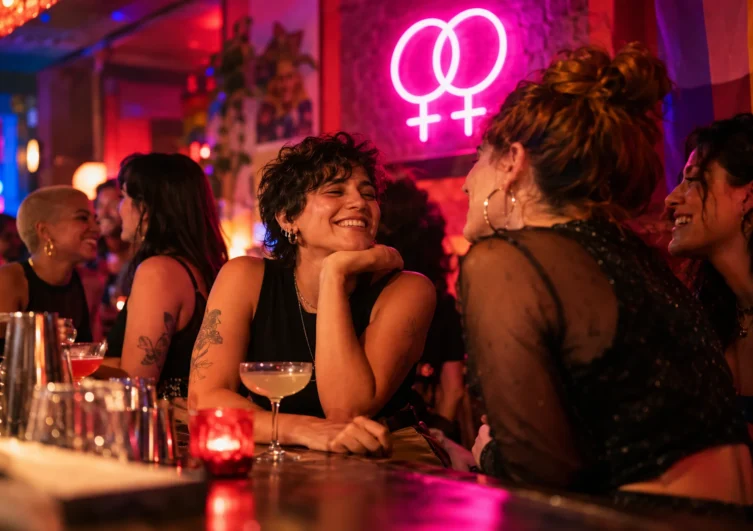
For years, lesbian bars have been making headlines for one reason: they keep closing. Newspapers document their disappearance, documentaries preserve their memories, and social media mourns another space lost to rising rents or changing nightlife habits.
But something important gets lost in all those obituaries. Lesbian bars are not simply relics of a disappearing culture. Across the world, queer women are opening new venues, organising events, and experimenting with different ways of bringing their communities together.
Perhaps it is time to stop asking why lesbian bars are dying and start paying attention to how they are surviving.
The numbers don’t tell the whole story
In the late 1980s, the United States had more than 200 lesbian bars. By 2020, that figure had fallen to approximately 15, an astonishing decline that helped inspire The Lesbian Bar Project, an initiative dedicated to preserving and supporting these spaces.
Yet the situation has changed. In 2026, The Lesbian Bar Project lists 36 lesbian bars across the United States.
That is still remarkably few for a country of more than 340 million people, but it also represents a significant recovery from the lowest point.
And the numbers cannot capture everything. They exclude countless temporary parties, community gatherings, cultural events, and informal meeting spaces that have become important parts of lesbian social life.
The story is no longer exclusively about disappearance. It is also about reinvention.
A new generation of lesbian spaces
In London, La Camionera illustrates what can happen when a community responds to something it is missing.
What began as a temporary lesbian bar in 2024 attracted overwhelming interest. The project eventually established a permanent home in Hackney, offering an alternative to traditional nightclubs.
Rather than relying entirely on loud music and late-night dancing, La Camionera offers an intimate setting where people can meet, talk, drink, and spend time together.
Elsewhere in London, La Monocle has taken a different route. Beginning with pop-up events, film screenings, and speed dating in South London, the project launched a fundraising effort in 2026 to establish a permanent lesbian and FLINTA venue.
Across the Atlantic, Brooklyn’s Boyfriend Co-op is experimenting with another model altogether. Opened in 2025, the queer café and cocktail bar combines hospitality with a co-operative structure that creates opportunities for workers and community members to participate in ownership.
Its programme includes poetry readings, karaoke, and community discussions alongside traditional bar service.
These are not identical businesses, nor are they trying to be. What connects them is the understanding that a successful queer space needs to offer something more meaningful than a place to buy alcohol.
Why running a lesbian bar is complicated
The economics of lesbian nightlife have always presented particular challenges.
Unlike mainstream venues, businesses catering primarily to queer women often serve a smaller potential customer base. Historically, women’s lower average earnings and different spending patterns have also affected the financial viability of such establishments.
Meanwhile, commercial rents, staffing expenses, insurance, and licensing costs continue regardless of how many customers walk through the door.
A packed Pride party might generate substantial revenue, but what happens on an ordinary Tuesday evening in February?
That is the question every permanent venue eventually faces.
Some operators have responded by diversifying their activities. Boston’s Dani’s Queer Bar, for example, combines nightlife with drag brunches, karaoke, bingo, and other community events.
Others are experimenting with cafés, private gatherings, partnerships, and alternative ownership models.
None of these approaches guarantees financial success. They do, however, challenge the idea that lesbian bars must operate exactly as they did several decades ago.
What do queer women actually want?
Perhaps the most important change concerns the people these spaces are supposed to serve.
Not everyone wants to spend Saturday night in a crowded nightclub. Some would rather meet friends over coffee, attend a book discussion, watch women’s football, or enjoy a drink somewhere they can actually hear the conversation.
Others still want the dance floor, the flirting, and the freedom of a night out without feeling like guests in somebody else’s space.
In Spain, organisations such as MíraLES have helped develop a social scene built around daytime parties, cultural activities, and shared experiences. A July 2026 report by El País highlighted how lesbian social life increasingly extends into reading groups, sporting events, travelling parties, and outdoor activities.
The appeal is not necessarily about abandoning nightlife. It is about creating more choices.
There is also the question of inclusion. Lesbian spaces today often welcome bisexual women, trans women, and non-binary people, reflecting the diversity of the communities that use them.
That evolution can generate debates about identity and belonging, but it also creates opportunities to build spaces that are both recognisably lesbian and welcoming to a broader queer community.
The importance of having somewhere to return to
Temporary events have become essential in cities where permanent lesbian venues no longer exist.
They allow organisers to experiment, attract audiences, and build communities without immediately taking on the financial risks of a commercial lease.
But a monthly party is not quite the same as having a familiar neighbourhood bar.
A permanent venue offers continuity. It is somewhere people can visit without planning weeks in advance, somewhere friendships develop unexpectedly and different generations encounter one another.
For decades, lesbian bars played precisely that role. They were social spaces, but also places where people discovered their identities, organised politically, found partners, and built friendships that lasted long after closing time.
That history deserves preservation. Yet preserving it should not mean expecting today’s lesbian communities to recreate yesterday’s nightlife.
The next generation of queer spaces may look different. Some will be bars. Others will be cafés, cultural centres, travelling events, or businesses owned collectively by the people who use them.
What matters is whether they can give people a sense of belonging while remaining financially sustainable.
The next time a lesbian bar opens, perhaps the headline should not frame it as a miraculous exception to an inevitable decline.
Perhaps we should simply recognise what is happening: queer women are still creating places for themselves, adapting to new circumstances and refusing to let their communities disappear.
Lesbian bars deserve to be remembered. But, more importantly, they deserve a future.
Leave a Reply