

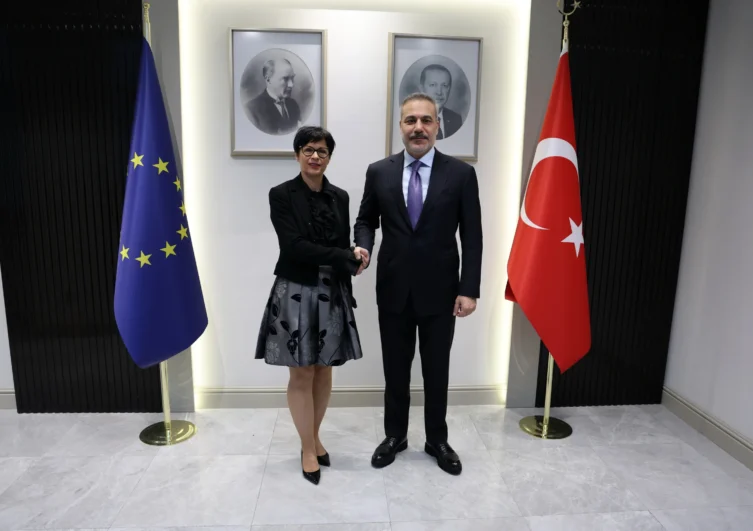
Turkey’s campaign against LGBTQ+ people and independent media is putting even more distance between Ankara and its long-standing ambition to join the European Union. The warning came from European Commissioner for Enlargement Marta Kos on October 9, as Turkish authorities continue to target LGBTQ+ organisations, activists and journalists under a government investigation presented as an effort to protect families.
Speaking during a visit to Edirne, in northwestern Turkey, Kos made clear that the European Union’s willingness to cooperate with Ankara does not mean Brussels is prepared to overlook concerns about fundamental rights. Her remarks followed a series of arrests, investigations and restrictions on independent reporting that have attracted growing international criticism.
Brussels draws a line over LGBTQ+ rights
Turkey has been an official candidate for European Union membership since 1999, with accession negotiations beginning in 2005. Those negotiations have effectively been frozen for years amid concerns about democratic standards, judicial independence and fundamental freedoms.
The latest developments have added another obstacle to an already troubled relationship. Kos specifically identified restrictions on LGBTQ+ rights, media freedom and local democracy as issues that are moving Turkey further away from the standards expected of a prospective EU member.
“The latest developments affecting media freedom, the rights of the LGBTQI+ people and local democracy are widening the gap with Turkey’s objective of joining the EU,” Kos told reporters, according to Reuters.
The commissioner also confirmed that the European Commission’s annual enlargement report, scheduled for October 28, will address these developments. She said the document would reflect Brussels’ serious concerns and stressed that she would not avoid speaking publicly about the situation.
The warning comes at a particularly sensitive moment for relations between Turkey and the European Union, as both sides seek closer economic and strategic cooperation despite their political disagreements.
A news website targeted over 118 articles
One of the most striking examples of Turkey’s latest restrictions involves T24, an independent Turkish news outlet that has faced legal action over its coverage of LGBTQ+ issues.
On September 30, a Turkish court ordered access to the outlet’s website and social media accounts to be blocked after authorities identified 118 pieces of content published over the previous year that they classified as “LGBT propaganda”.
The ruling was connected to an investigation known as My Family is Safe, which Turkish authorities say is intended to protect children and traditional family values. However, the investigation has extended beyond individual publications to include LGBTQ+ organisations, activists and other independent voices.
T24 said it had not yet received formal notification of the decision when it was reported and intended to challenge the ruling through the courts.
The case has raised concerns about the increasingly blurred boundaries between restrictions on LGBTQ+ visibility and restrictions on journalism itself. By treating reporting about LGBTQ+ people as potentially unlawful propaganda, the authorities have created a situation in which independent media organisations may face consequences simply for covering issues affecting part of the population.
Arrests and raids intensify pressure on LGBTQ+ communities
The restrictions on media coverage follow a broader series of police operations targeting LGBTQ+ people and organisations across Turkey.
In September, Turkish authorities detained activists and individuals accused of involvement in activities linked to the My Family is Safe investigation. Reuters reported that at least 31 people had been jailed pending trial, while 126 protesters were detained during demonstrations against the arrests.
The operations included raids on association offices and investigations extending across multiple provinces. Among those targeted were transgender women, LGBTQ+ activists and people involved in community organisations.
Human rights organisations have criticised the campaign, warning that the authorities are using the protection of families as a justification for restricting fundamental freedoms. The Council of Europe’s Commissioner for Human Rights, Michael O’Flaherty, has also raised concerns about the detention of people involved in civil society and human rights work.
The Turkish government maintains that its policies are intended to defend family values and protect children. Rights organisations, however, argue that the measures threaten freedom of association, expression and the ability of LGBTQ+ people to participate openly in public life.
For LGBTQ+ communities in Turkey, the consequences extend beyond the immediate arrests. The targeting of organisations and independent media also threatens access to information, community support and the visibility of people who already face significant social and political pressure.
Europe still needs Turkey, despite growing tensions
Despite the increasingly strained relationship, the European Union is not preparing to abandon cooperation with Turkey. Kos acknowledged that the country’s strategic importance has grown considerably in recent years, particularly because of instability around the Black Sea and Russia’s war against Ukraine.
Turkey remains a NATO member, a major regional power and an important economic partner for the European Union. Ankara has also expressed interest in updating its customs union with the bloc and participating in European initiatives involving defence, payments and industrial development.
Among the programmes Turkey has sought to join are Security Action for Europe (SAFE), the Single Euro Payments Area (SEPA) and initiatives associated with the EU’s Made in Europe industrial framework.
Kos indicated that Brussels is pursuing discussions on a targeted update of the customs union and on public procurement rules, although progress would require legislative changes and closer alignment with European standards.
This creates an increasingly complicated relationship. While the EU considers cooperation with Turkey important for security and economic reasons, its enlargement commissioner is simultaneously warning that the country’s domestic policies are making membership more difficult.
October 28 could bring further criticism
The European Commission’s enlargement report, expected on October 28, will provide the next formal assessment of Turkey’s progress towards EU membership.
Although the country’s accession process has been stalled for years, the report remains an important measure of how Brussels evaluates democratic standards, human rights and the rule of law in candidate countries.
Kos has already indicated that recent developments involving LGBTQ+ rights, independent media and local democracy will feature prominently in that assessment.
For Turkey, the immediate question is no longer simply when negotiations might resume, but how its ambitions for closer European integration can coexist with policies that European officials say contradict the fundamental principles of the Union.
For LGBTQ+ people in Turkey, the stakes are considerably more immediate. While Brussels and Ankara negotiate their future relationship, activists, journalists and community organisations are already confronting the consequences of the government’s latest restrictions.
Photo Credit
Photo: © European Union, 2026 / CC BY 4.0


Leave a Reply