


What actually happens during male-to-female bottom surgery? Here’s how vaginoplasty and vulvoplasty use existing tissue to create new anatomy while preserving sensation and urinary function.
For many people, gender-affirming surgery is something they have heard about without ever really understanding what actually happens during it.
Actress and model Hunter Schafer is one of the latest and most recognisable transgender women to speak publicly about having gender-affirming bottom surgery. In an October 2026 interview with ELLE, Schafer revealed that she underwent surgery in December 2025 and said she was extremely happy with the result. Surgery, however, is a personal choice, not a requirement of being transgender, and many trans people never undergo genital surgery at all.
For transgender women who do choose surgery, there are two main approaches to creating female external genital anatomy: vaginoplasty, which creates both a vulva and a vaginal canal, and vulvoplasty, which creates the external vulva without a full-depth vaginal canal.
Vaginoplasty: Creating a Vulva and Vaginal Canal
Vaginoplasty is the procedure most people think of when they hear about male-to-female genital surgery.
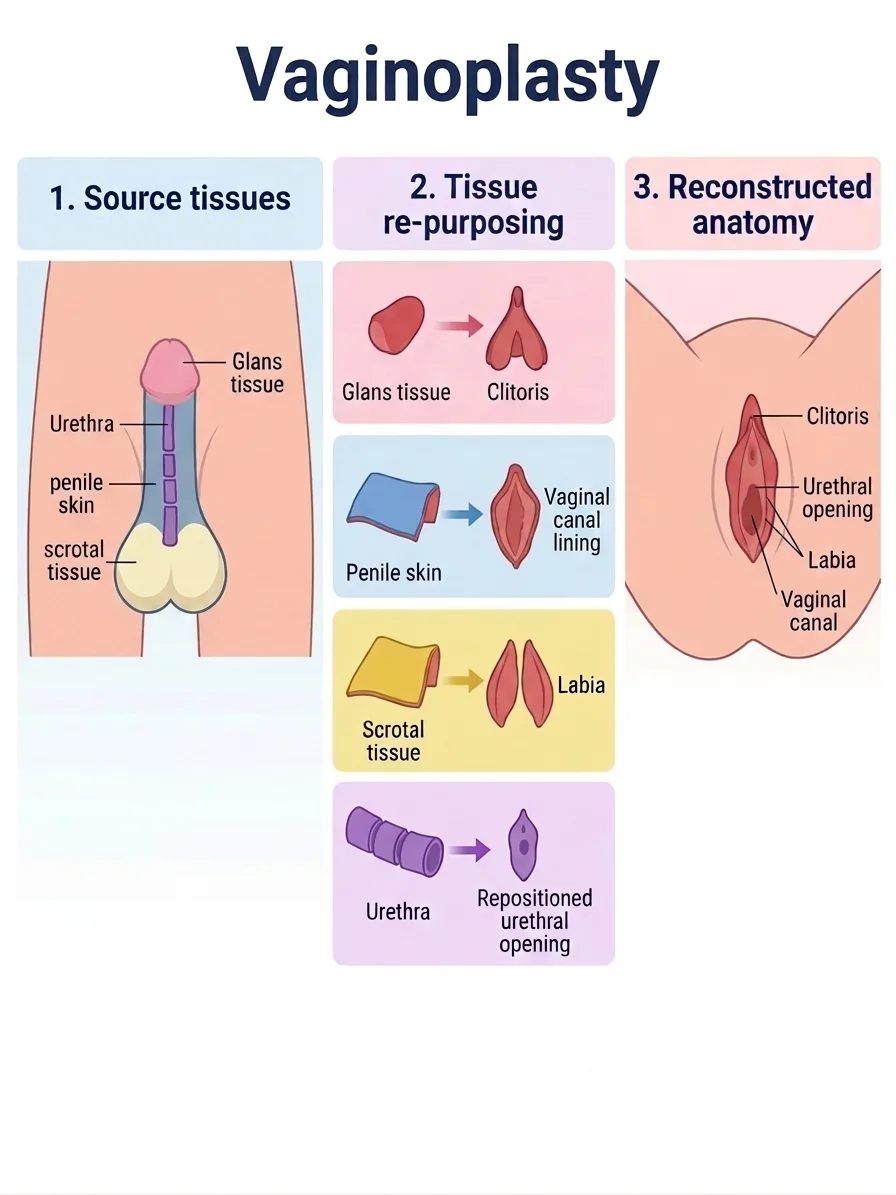
The important thing to understand is that the penis is not simply pushed inside the body to become a vagina. Instead, surgeons carefully separate the different tissues and reuse them to construct new anatomy.
The skin of the penis is separated from the erectile tissue underneath while preserving as much useful skin, nerve supply and blood flow as possible. The erectile tissue that normally allows the penis to become erect is largely removed or reduced.
The surgeon then creates a new space inside the pelvis, between the urethra and the rectum. This becomes the vaginal canal.
The preserved penile skin is turned inward, almost like turning a sleeve inside out, and used to line that new canal. This is why the most established technique is called penile inversion vaginoplasty. Depending on the technique and the amount of available tissue, surgeons may also use scrotal skin or other tissue to help create or extend the canal.
Other parts of the existing anatomy are also reused. A small portion of the glans, the highly sensitive head of the penis, is preserved together with its nerves and blood vessels and reshaped to form a clitoris. Preserving those nerve endings is crucial because it allows the new clitoris to retain erotic sensation and makes orgasm possible for many patients.
The scrotal skin is commonly used to help create the labia, forming the outer appearance of the vulva.
The urethra, which carries urine from the bladder, is also preserved. It is shortened and repositioned so that urine exits from a location more typical of female anatomy. That means urinary function is maintained; the route is simply altered to fit the reconstructed genital anatomy.
The testicles are usually removed as part of the surgery, which also significantly reduces testosterone production. The prostate is normally left in place.
After surgery, patients who have a full-depth vaginal canal usually need to use medical dilators regularly while healing. This helps the new vagina maintain its depth and width.
Once healing is complete, the vaginal canal can also be used for receptive penetrative sex. Because the canal is surgically created rather than naturally self-maintaining, regular dilation during recovery is important to prevent healing tissues and scar tissue from narrowing it. Johns Hopkins Medicine notes that a full-depth vaginoplasty is designed to make receptive vaginal intercourse possible and that dilation is a key part of recovery. Most surgeons recommend waiting several months before penetrative vaginal sex, with the exact timing depending on healing and the surgeon’s advice.
Vulvoplasty: Creating the External Vulva Without a Vaginal Canal
Not every transgender woman wants or needs a full-depth vagina.
A vulvoplasty, sometimes called zero-depth or shallow-depth vaginoplasty, creates the external female genital anatomy without constructing a full vaginal canal.
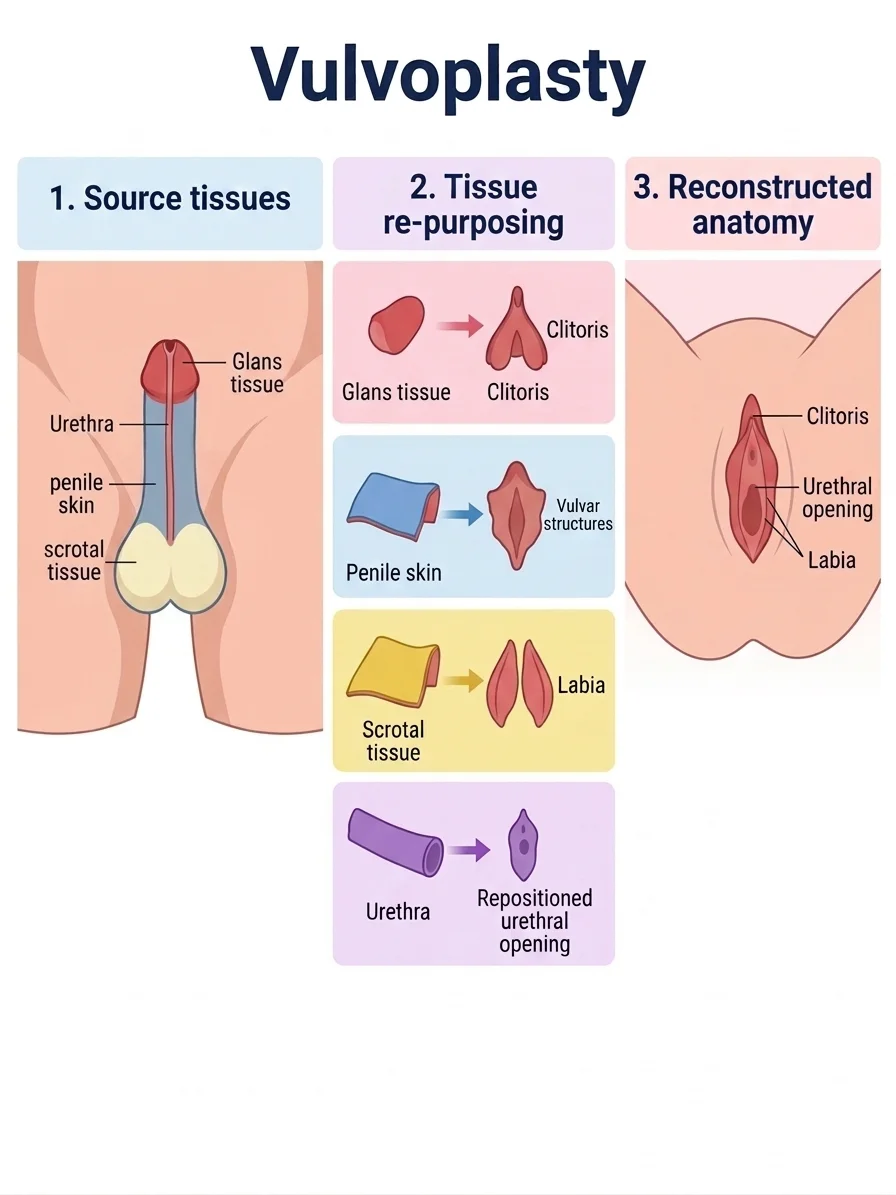
The basic reconstruction is similar in some ways to vaginoplasty. Tissue from the penis and scrotum is reshaped to form the labia and vulva, and part of the glans is preserved with its nerve supply and used to create a clitoris.
The urethra is also shortened and repositioned so that the person continues to urinate normally from the new anatomical position.
The major difference is what happens internally: surgeons do not create the deeper space between the urethra and rectum, and penile skin does not need to be used to line a full vaginal canal.
Because there is no full-depth vagina, patients generally do not need the same long-term dilation routine required after vaginoplasty.
Vulvoplasty can therefore be an option for people who want female external genital anatomy, preserved sexual sensation and normal urinary function, but who do not want or need penetrative vaginal intercourse.
Preserving Sensation and Function
One of the most important goals of either operation is not simply appearance, but function.
Surgeons deliberately preserve the nerve and blood supply to the tissue used to create the clitoris. This is what allows touch and sexual sensation to remain possible. Johns Hopkins notes that the vast majority of patients are able to orgasm after vaginoplasty, although the sensation associated with orgasm may feel different after surgery.
First-hand accounts also make clear just how personal the outcome can be. Schafer described her own surgery as “amazing” and said, “I love it so much.” A Mount Sinai patient named Lexi said her surgical results and recovery had “exceeded my expectations.” These are individual experiences, but they underline that the goal is not simply to change anatomy; it is to help a person feel more at home in their own body.
The urinary system is also preserved. The bladder remains unchanged, while the urethra is shortened and repositioned so urine can still pass normally.
So the surgery is not a case of removing everything and replacing it with artificial parts. It is a sophisticated reconstruction using the body’s own tissue.
In simplified terms, penile skin can become the vaginal lining, part of the glans becomes the clitoris, scrotal skin helps form the labia, and the urethra is repositioned so urination continues to work.
That is what makes gender-affirming genital surgery less mysterious than it may first sound: the anatomy is not discarded. It is carefully reorganised.
But perhaps the most important part of the decision comes before the operating theatre. Anyone considering surgery needs to understand what can change, what may feel different afterwards, what the procedure can realistically achieve and what it cannot. Sensation, sexuality and the relationship someone has with their own body can all evolve after surgery, and those possibilities deserve careful thought and honest discussion.
Ultimately, the goal is not anatomical perfection. It is helping someone reach a point where their body feels more aligned with who they understand themselves to be — a greater sense of comfort, wholeness and harmony between the inner self and the body they live in.



Leave a Reply