

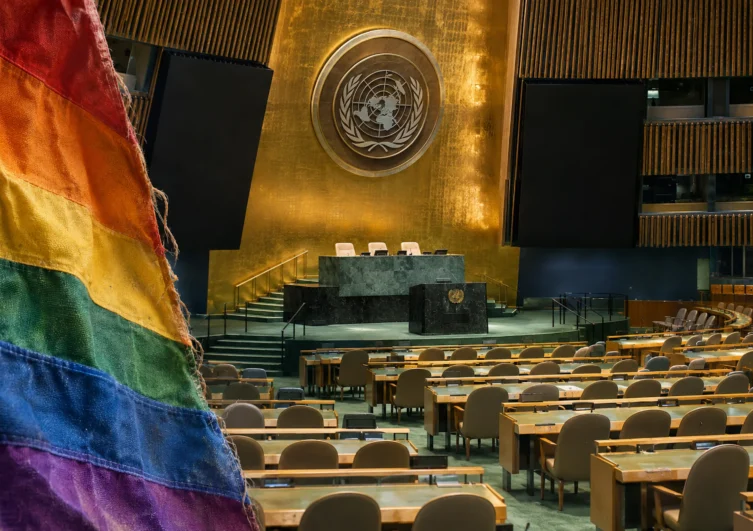
Update, 16 November 2026: On 13 November, the UN General Assembly’s Third Committee voted 74–69 against removing references to sexual orientation and gender identity from the draft resolution on unlawful killings. The United States voted for removal, reversing its position in 2024. The wording now goes to the full General Assembly, which is expected to vote in December.
Every two years, the United Nations adopts a resolution condemning extrajudicial, summary and arbitrary executions. It calls on governments to prevent unlawful killings, investigate them and bring those responsible to justice. It also identifies groups especially vulnerable to being killed, including people targeted because of their sexual orientation or gender identity.
That final reference is once again at stake as UN member states prepare to negotiate and vote on the resolution in November 2026. The issue is not whether LGBTQ+ people have a right to life, that right applies to everyone. It is whether the UN will continue to name explicitly the danger faced by people killed because of who they are.
The concern is far from hypothetical. In 2024, 47 countries supported an unsuccessful attempt to remove the words referring to sexual orientation and gender identity. And in December 2025, a comparable attempt to delete those references from a different UN resolution actually succeeded.
The 47 countries that supported removing LGBTQ+ references
At the UN General Assembly’s Third Committee in November 2024, a group of 14 countries formally proposed an amendment to the resolution on unlawful executions. The proposal, introduced by Egypt and co-sponsored by countries including Russia, Iran, Saudi Arabia, Nigeria and Uganda, sought to replace the phrase “sexual orientation or gender identity” with “sex”.
The amendment attracted 47 votes in favour, including China, India, Indonesia, Jamaica, Pakistan and the United Arab Emirates. Another 26 countries abstained, while 42 did not vote. The proposal was defeated by 78 votes against it.
Among those opposing the removal were Brazil, Portugal, the United Kingdom and the United States. Angola and Mozambique abstained; Guinea-Bissau did not vote. Timor-Leste supported the removal, having voted against a similar proposal in 2022.
These were votes on the proposed deletion, not votes in favour of unlawful killings. The resolution itself subsequently passed, with the LGBTQ+ references intact. Nevertheless, the amendment revealed how many governments were prepared to eliminate the explicit recognition of this particular risk.
The results and each country’s position are documented in a briefing by Outright International and the International Service for Human Rights, while the original amendment is available in the UN’s records.
Why naming LGBTQ+ victims matters
The distinction may seem symbolic, but it has practical importance. The resolution does more than condemn killing in general: it urges states to investigate deaths involving people targeted for discriminatory reasons and to ensure perpetrators do not escape accountability.
Naming sexual orientation and gender identity acknowledges that prejudice can be a factor in fatal violence — and that authorities must be alert to it when investigating a death.
Removing the words would not legalise murder, cancel international human rights law or strip LGBTQ+ people of their fundamental right to life. It would, however, erase a specific recognition that has appeared in this UN process for more than two decades: sexual orientation since 2002 and gender identity since 2012.
As the governments of Australia, Canada, Liechtenstein, New Zealand and Switzerland argued in 2024, deleting one vulnerable group from the list would send a dangerous signal about whose lives merit particular attention.
In 2025, a similar deletion succeeded
This year’s debate takes place after a significant setback at the UN.
In December 2025, a proposed reference to sexual orientation and gender identity in a resolution on the rights of persons with disabilities survived an initial challenge in the Third Committee. But opponents reintroduced a deletion amendment in the full General Assembly, where it passed. The final resolution was adopted without the reference.
The two resolutions address different issues, and the 2025 decision does not determine the outcome of the 2026 vote. But it demonstrates that language which survives committee negotiations can still be removed later in the process.
The UN amendment from December 2025 and the International Service for Human Rights’ 2026 briefing document that precedent.
More than 230 killings documented — and an unknown number uncounted
The dispute over wording coincides with stark new evidence about the violence it is intended to address.
In October, Outright International released Killed for Who They Are, a report documenting more than 230 suspected bias-motivated killings of LGBTIQ people between January 2020 and July 2026. The cases span different regions and include victims aged between 12 and 77.
The figures are not a global death toll. They represent cases for which the researchers found sufficient evidence. In countries where people risk arrest or persecution because of their identities, crimes are especially difficult to report and document.
According to the report, 65 UN member states still criminalise consensual same-sex acts. Only 63 of the 193 member states recognise hate crimes based on sexual orientation, and just 40 do so on the basis of gender identity. When a victim’s identity or the motive for a killing goes unrecorded, the prejudice behind the crime may disappear from the official account.
The report also examines how police inaction, discriminatory laws and impunity can leave victims and their families without justice. Its findings make the stakes of the UN’s language debate concrete: recognising a pattern of violence is one step towards investigating it.
The full findings are available in Outright International’s Killed for Who They Are report.
What happens at the UN in November?
Finland is leading this year’s biennial resolution, which is due to be considered during the Third Committee’s session ending on 20 November 2026. A subsequent General Assembly vote may follow. As of 6 November, a precise voting date and the text of any new amendment seeking to remove the LGBTQ+ references had not been confirmed in the public materials reviewed for this article.
The diplomatic climate has also changed. The International Service for Human Rights reports that, in September 2026, the United States and other governments announced a new coalition framed around “life and family”, which the organisation sees as a counterweight to pro-LGBTIQ diplomacy. That does not establish how the United States will vote on this particular resolution; in 2024, it opposed the deletion.
Outright International, alongside Amnesty International, Human Rights Watch, ILGA World and the International Service for Human Rights, is urging UN member states to keep the references. The organisation has also launched a public petition, with signatures intended for the 193 UN member states before the vote.
For now, the resolution still explicitly recognises people targeted because of sexual orientation or gender identity. The upcoming decision will show whether governments are willing to preserve that recognition, even after a year in which comparable language was successfully removed from another UN text.
Contribute
We value different opinions and stories! Want to contribute yours? Get in touch!
One response
-
[…] years ago, 47 countries supported removing the LGBTQ+ references. This year, that number increased to […]
Leave a Reply