

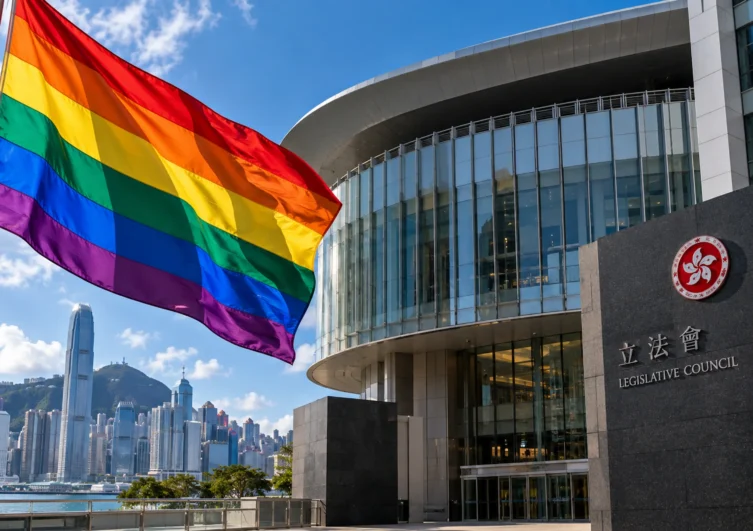
One year ago, Hong Kong’s Legislative Council rejected a government bill that would have created a legal registration system for same-sex partnerships.
The vote was decisive: 71 lawmakers voted against the bill, 14 supported it and one abstained. The legislation had been introduced after Hong Kong’s Court of Final Appeal ruled in 2023 that the government had a positive obligation to establish an alternative framework giving same-sex couples legal recognition and protection.
Twelve months later, the central question has not disappeared. If anything, it has become more complicated: what happens when a court requires legal recognition, but the legislature rejects the government’s proposed mechanism?
A court ruling, followed by a political defeat
The origins of the dispute go back to the case brought by LGBTQ+ activist Jimmy Sham.
In 2023, Hong Kong’s Court of Final Appeal ruled that the government had a positive obligation to establish an alternative legal framework for recognising same-sex partnerships. The court did not require Hong Kong to introduce same-sex marriage, but it did require some form of legal recognition and protection.
The government subsequently proposed the Registration of Same-sex Partnerships Bill.
The proposed system would have allowed eligible same-sex couples to register their partnerships and would have provided certain rights and obligations associated with that status.
However, the government made clear that the proposal was not equivalent to marriage and that Hong Kong’s existing definition of marriage as a relationship between a man and a woman would remain unchanged.
That distinction did not save the bill.
On 10 September 2025, lawmakers rejected it by a large majority.
What did the bill actually offer?
The proposed legislation was deliberately narrower than marriage equality.
It would have created a registration system for same-sex partnerships and amended other legislation to provide certain rights and obligations to registered couples.
The government argued that this would satisfy the Court of Final Appeal’s requirement to establish an alternative framework while maintaining Hong Kong’s existing heterosexual marriage system.
Critics, however, argued that the proposed framework did not go far enough and questioned whether it genuinely fulfilled the court’s requirements.
The result was a rare situation in which the government had proposed legislation in response to a binding court ruling, only for the legislature to reject it.
So what happens now?
After the vote, the government said it would not seek an extension of the court’s deadline and would instead discuss the issue with the Department of Justice.
A year later, the question remains unresolved.
According to the South China Morning Post, the government has been considering whether an administrative solutioncould provide some protections without introducing another piece of legislation.
For same-sex couples, that leaves a patchwork of rights rather than a single, comprehensive legal status. Some protections already exist in specific areas, particularly where courts have ruled in favour of individual couples.
Hong Kong’s immigration policy, for example, allows certain same-sex partners whose relationships were legally recognised overseas to apply for dependant status.
But recognition in one area does not automatically translate into recognition across the legal system.
A year in limbo
The consequences are not purely symbolic.
Legal recognition can affect matters such as immigration, family rights, inheritance, taxation, medical decisions and access to benefits.
Hong Kong has already recognised some rights for same-sex couples through individual court cases. But the absence of a single legal framework means couples may still have to rely on separate rules, policies or court decisions depending on the issue involved.
That has created what many describe as a patchwork system: some rights exist, while others remain uncertain or unavailable.
Hong Kong’s unusual position
Hong Kong therefore occupies an unusual position in Asia.
The territory does not recognise same-sex marriage, yet courts have progressively expanded certain protections for same-sex couples.
The Court of Final Appeal’s 2023 decision represented another step in that process by explicitly requiring the government to establish an alternative recognition framework.
But the rejection of the government’s bill demonstrated the limits of that judicial progress when it reaches the legislative process.
For LGBTQ+ Hongkongers, the debate is therefore no longer simply about whether same-sex relationships should receive legal recognition.
It is also about what that recognition should look like, who should provide it and how far it should extend.
The question that remains
A year after the Legislative Council’s vote, Hong Kong has not returned to the legal position of 2023. The court’s ruling still stands, and the government remains under an obligation to address the legal recognition of same-sex partnerships.
But the route towards that recognition remains unresolved.
For couples who have spent years fighting for legal certainty, the biggest change since last year’s vote may be that the question has become harder to ignore.
The bill is gone.
The legal question is not.

Leave a Reply