

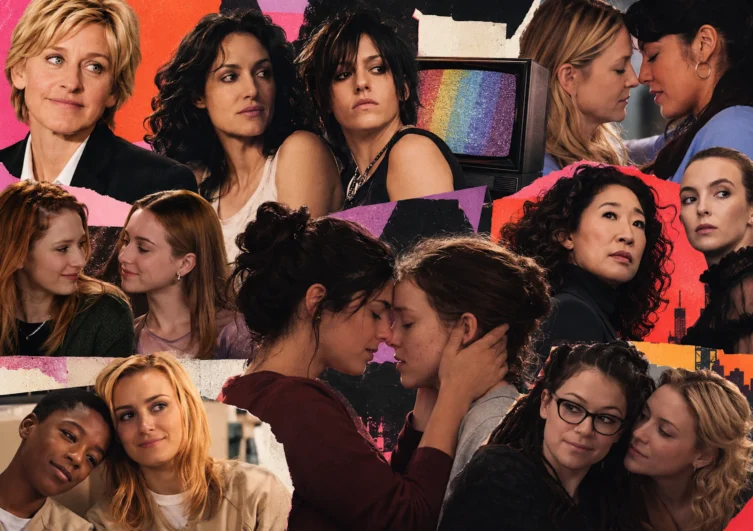
There was a time when a lesbian character appearing on television was enough to make headlines. Sometimes she was a supporting character, sometimes her sexuality was revealed in a dramatic confession, and sometimes she disappeared almost as quickly as she arrived. Happy endings were far from guaranteed, and finding a relationship between two women that lasted longer than a season could feel like a minor miracle.
Today, lesbian characters can lead crime dramas, fall in love in period romances, survive supernatural disasters and make terrible decisions in ordinary sitcoms. That change didn’t happen overnight. It took a handful of characters, some groundbreaking performances and more than a few television controversies to get here.
Ellen Morgan — Ellen (1997)
In 1997, Ellen DeGeneres did something that television executives had spent years treating as almost unthinkable. Her character, Ellen Morgan, came out as gay in an episode appropriately titled “The Puppy Episode”.
It wasn’t simply another television storyline. DeGeneres came out publicly around the same time, and the episode became a cultural event, attracting enormous attention and controversy. Oprah Winfrey appeared as Ellen’s therapist, while Laura Dern played the woman who helped her recognise her feelings.
The consequences were considerable. Advertisers faced pressure, conservative organisations protested, and the series was cancelled the following year. Dern later spoke about the professional difficulties she experienced after appearing in the episode.
Ellen Morgan wasn’t the first lesbian character on American television, but her coming-out story changed the conversation. For millions of viewers, it was the first time they had watched a major sitcom protagonist openly acknowledge that she was gay.
Willow Rosenberg — Buffy the Vampire Slayer (1997–2003)
Willow Rosenberg began Buffy the Vampire Slayer as the shy, academically gifted best friend of a teenage vampire hunter. By the end of the series, she had become one of television’s most recognisable queer characters.
Her relationship with Tara Maclay developed gradually, beginning with their shared interest in witchcraft before becoming explicitly romantic. At a time when same-sex relationships were still frequently treated as shocking revelations, Willow and Tara were allowed to experience affection, jealousy, domestic routines and the complications of being a couple.
Their first on-screen kiss came in 2001, during one of the show’s most emotionally devastating episodes. Rather than presenting the moment as a sensational event, the series placed it within a story about grief.
But Buffy also contributed to one of television’s most enduring controversies. Tara’s death in the sixth season devastated viewers and became a frequently cited example in discussions of the “Bury Your Gays” trope, in which LGBTQ+ characters are disproportionately associated with tragedy.
Willow and Tara helped make lesbian relationships visible in mainstream fantasy television. Their story also demonstrated why representation involves more than simply introducing queer characters.
Bette Porter and Shane McCutcheon — The L Word (2004–2009)
When The L Word premiered in 2004, it offered something that mainstream American television had rarely attempted: an entire drama built around the friendships, careers, relationships and sex lives of lesbian and bisexual women.
Rather than making one character’s sexuality the central revelation, the series introduced a social world in which being queer was simply part of everyday life.
Bette Porter, played by Jennifer Beals, was ambitious, sophisticated, controlling and frequently infuriating. Shane McCutcheon, played by Katherine Moennig, became an almost instant queer icon, with her androgynous appearance, complicated romantic life and apparent inability to commit.
Neither character was designed to be a perfect role model. Bette could be selfish and manipulative. Shane broke hearts almost as frequently as she attracted admirers. That was precisely part of the appeal.
For once, lesbian characters were allowed to be glamorous, successful, sexually adventurous, insecure, unfaithful and occasionally ridiculous without their sexuality having to explain every decision.
The series was criticised for its limited diversity and some of its portrayals, particularly involving bisexual and transgender characters. Nevertheless, its influence was undeniable. It inspired discussion, fashion, nightlife and a sense of recognition among viewers who had rarely seen their social lives reflected on television.
Years later, The L Word: Generation Q attempted to revisit that world for a different generation. Whatever its shortcomings, the original series had already established that lesbian lives could sustain an entire television universe.
Callie Torres and Arizona Robbins — Grey’s Anatomy (2005–)
Medical dramas have always been full of complicated romances, but Grey’s Anatomy helped bring one of television’s most prominent relationships between women into millions of living rooms.
Callie Torres, played by Sara Ramirez, was introduced as a romantic interest for George O’Malley before her story evolved to explore her bisexuality. Arizona Robbins, played by Jessica Capshaw, arrived as a confident paediatric surgeon whose sexuality was never presented as something she needed to apologise for.
Their relationship included marriage, parenthood, professional conflicts, infidelity and a painful separation. In other words, they experienced the kind of elaborate romantic chaos that Grey’s Anatomy had been giving its heterosexual couples for years.
Their wedding in 2011 was particularly significant. At a time when same-sex marriage was still unavailable across much of the United States, a major network drama presented two women celebrating their commitment in front of family and friends.
Callie and Arizona weren’t always happy, and their relationship certainly wasn’t always healthy. But they were central characters whose personal lives mattered to the larger story, rather than occasional guests brought in to deliver a message about tolerance.
Cosima Niehaus — Orphan Black (2013–2017)
Tatiana Maslany played numerous genetically identical women in Orphan Black, but Cosima Niehaus quickly became one of its most beloved characters.
A brilliant scientist with dreadlocks, a rebellious streak and an infectious enthusiasm for biology, Cosima was openly attracted to women. Her sexuality was never treated as a dramatic secret or a problem to be solved.
Her relationship with Delphine Cormier, played by Évelyne Brochu, became one of the show’s emotional anchors, even as the characters navigated conspiracies, betrayals and scientific experiments.
What made Cosima particularly memorable was how comfortably her sexuality existed alongside everything else that defined her. She was intelligent, funny, vulnerable, stubborn and occasionally reckless. Being queer was an important part of her identity, but it wasn’t her entire personality.
In a genre where LGBTQ+ characters had often been sidelined or sacrificed for dramatic effect, Cosima was given a substantial story and, importantly, a hopeful ending.
Nicky Nichols and Poussey Washington — Orange Is the New Black (2013–2019)
Before Orange Is the New Black, lesbian and bisexual women were still relatively uncommon as central figures in major television ensembles. Netflix’s prison drama changed that by introducing a large cast of women whose sexuality, relationships and experiences varied enormously.
Nicky Nichols, played by Natasha Lyonne, was sarcastic, sexually confident and deeply vulnerable beneath her sharp humour. Her struggles with addiction and her complicated friendships gave her a depth that went far beyond her romantic relationships.
Poussey Washington, played by Samira Wiley, brought warmth, intelligence and emotional sincerity to the series. Her relationship with Soso offered moments of tenderness within an environment frequently defined by cruelty.
Poussey’s death in the fourth season became one of the show’s most controversial moments. It was intended to confront institutional violence and injustice, but it also raised questions about the repeated use of queer women’s suffering as a dramatic device.
The significance of Orange Is the New Black wasn’t that every character received a satisfying storyline. It was that the series allowed queer women of different backgrounds, races, ages and personalities to occupy the centre of the narrative.
They could be funny, cruel, generous, selfish, sexually adventurous or emotionally reserved. There was no single model of what a lesbian character was supposed to look like.
Villanelle and Eve Polastri — Killing Eve (2018–2022)
Few television relationships have generated as much fascination, frustration and online discussion as the one between Villanelle and Eve Polastri.
Villanelle, played by Jodie Comer, was a stylish, unpredictable assassin whose attraction to women was established without hesitation. Eve, played by Sandra Oh, began as an intelligence investigator whose obsession with Villanelle gradually blurred the boundaries between professional pursuit, fascination and desire.
Their relationship was dangerous, obsessive and often destructive. It also gave audiences two complex women whose attraction was neither simple nor easily categorised.
Villanelle became a fashion icon, an internet obsession and one of the most recognisable queer characters of the late 2010s.
The series finale, however, provoked a fierce backlash. After years of romantic tension, the two women finally acknowledged their feelings, only for Villanelle to be killed shortly afterwards.
For many viewers, the ending felt like another example of television allowing queer women a moment of happiness before taking it away.
Whatever the intentions of its writers, Killing Eve demonstrated how deeply audiences had become invested in seeing relationships between women treated with the same narrative possibilities as heterosexual romances.
Ellie Williams — The Last of Us (2023–)
Ellie Williams entered television with an advantage that many earlier lesbian characters never had: her sexuality was already an established part of her story in the video games.
Played by Bella Ramsey, Ellie is funny, stubborn, traumatised and fiercely loyal. She is also a teenage girl growing up in a world devastated by a fungal pandemic, where surviving the next day often matters more than conventional social expectations.
The first season’s episode “Left Behind” explored Ellie’s relationship with Riley, played by Storm Reid, showing their affection through the awkwardness, excitement and vulnerability of first love.
It was a story about two girls discovering their feelings for each other, even as the world around them was collapsing.
Ellie’s relationship with Dina, introduced in the second season, further established her sexuality as an ordinary part of her character rather than a revelation designed to shock the audience.
What distinguishes Ellie is that she occupies the centre of a major action-horror franchise. Her sexuality doesn’t define the genre, limit her ambitions or prevent her from being the hero of a story about survival, violence, grief and love.
From coming out to simply existing
Looking back at these characters reveals how much television has changed. Ellen Morgan’s coming out required a special episode and became a national controversy. Willow and Tara’s relationship developed in an era when even an on-screen kiss could be considered groundbreaking. The L Word created a television world in which queer women no longer had to exist on the margins of somebody else’s story.
Today, a lesbian character can be a scientist, a surgeon, a detective, a prisoner, an assassin or a survivor of the apocalypse. She can be sympathetic or unbearable, faithful or unfaithful, heroic or morally questionable.
There are still familiar problems. Queer women continue to face premature deaths, abrupt cancellations and romantic storylines that end in disappointment. Greater visibility hasn’t automatically produced better writing.
But perhaps the most significant change is that lesbian characters no longer have to represent every lesbian viewer. There are enough different stories, at least in some corners of television, for audiences to disagree about which characters they love, which relationships they believe in and which endings they despise.
And that might be the most meaningful kind of progress: reaching a point where a lesbian character doesn’t have to change television simply by existing. She can change it by being unforgettable.

Leave a Reply